
A denim jacket fits right when the shoulder seams sit at the edge of your shoulder bone, the sleeves stop at your wrist bone, and the hem lands at your waist or just below with enough room to button over a T-shirt. The precious lamb builds every jacket around that formula, and it lines up with what style authorities like Art of Manliness recommend. The sections below show you exactly how to check it.
TL;DR:
- The shoulder seam should sit exactly at the edge of your shoulder bone, with the jacket allowing natural movement without restrictiveness.
- Sleeve length should land at or just below the wrist bone, and sleeves should have enough width for layering over T-shirts or light sweaters.
- When buttoned, the jacket should have enough ease across the chest and stomach, with minimal pulling or bunching, and slight waist shaping improves fit.
- The typical length is at or slightly above the waist, but modern styles can extend up to two inches below, affecting comfort and layering.
- Fit tests should prioritize movement and layer compatibility over mirror appearance, with specific measurements guiding appropriate size choices.
Table of Contents
- Denim Jacket Fit Starts at the Shoulders
- Getting Sleeve Length and Width Right
- The Torso and Button Test
- Where Should the Hem Land?
- Should You Size Up for Layering?
- How to Measure Your Denim Jacket Fit
- Matching Denim Jacket Fit to Your Style
- Thepreciouslamb’s Approach to Denim Jacket Fit
- Do Trucker and Bomber Denim Jackets Fit the Same Way?
- What Actually Matters When You’re Fitting a Denim Jacket
- Shop Denim Jackets Built Around These Fit Rules
- Sources
Denim Jacket Fit Starts at the Shoulders
The shoulder seam is the first thing to check and the hardest thing to fake with alterations. Get it wrong, and no amount of tailoring elsewhere saves the jacket.
A properly placed shoulder seam sits right at the edge of your shoulder bone, where your arm meets your torso. According to The Essential Man, seams that slide down onto your biceps mean the jacket runs too big; seams that creep up toward your neck mean it’s too small. Neither looks intentional. A jacket sized correctly through the shoulders reads structured without looking like it belongs to someone else.
The visual cues are easy to spot in a mirror. Look for:
- Fabric that lies flat across the top of your shoulder with no bunching or divot
- A seam line you can trace straight across, not curving down your arm
- No pulling or stretching when your arms hang naturally at your sides
Once the seam looks right, test it in motion. Reach both arms straight out in front of you like you’re grabbing something off a shelf, then shrug your shoulders up toward your ears. A jacket that fits will let you do both without the back panel yanking tight or the sleeves riding up past your wrist. If you feel resistance across your upper back during the reach, the jacket is cutting your mobility, even if it looked fine standing still.
There’s a small judgment call here worth knowing about. A seam that sits exactly on the bone gives you the cleanest silhouette, but if you’re between sizes, lean toward the slightly broader shoulder rather than the tighter one. A shoulder that’s a touch wide can be worn confidently and even tailored down slightly by a competent alterations shop. A shoulder that’s too narrow restricts movement in a way no tailor can fully fix without replacing the sleeve entirely.
Getting Sleeve Length and Width Right
Your wrist bone is the landmark that matters here, not your knuckles and not your forearm. The sleeve hem should land right at or just below that bone when your arm is relaxed at your side.
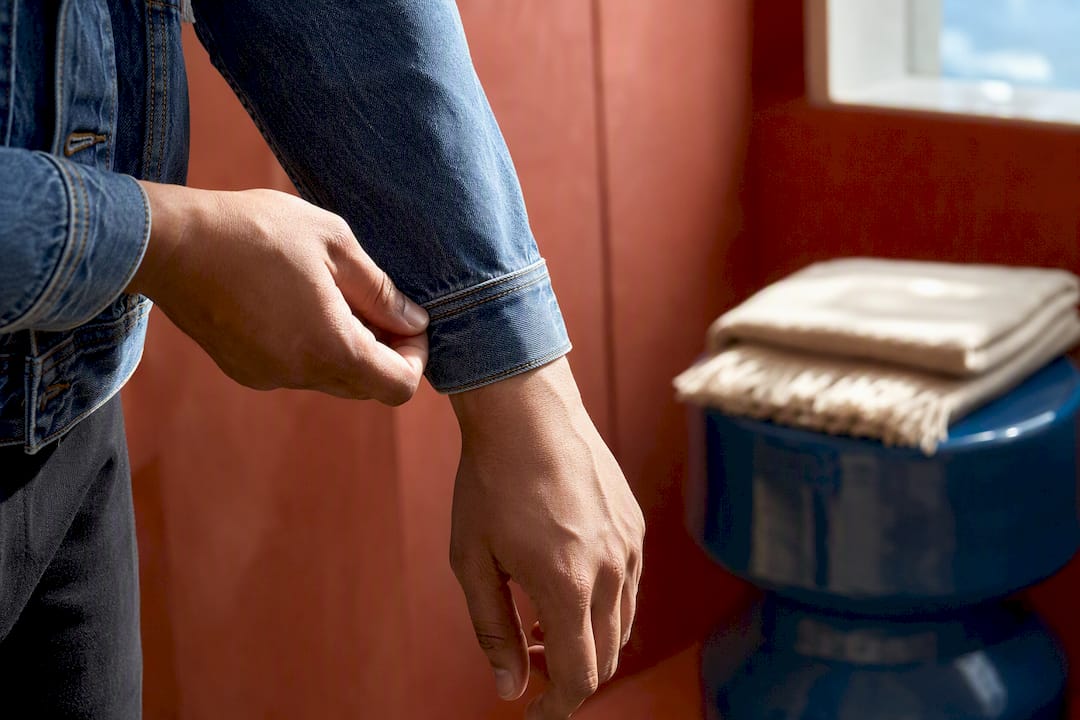
A little slack is fine and even preferable to a sleeve that stops short. You want enough length that the cuff can be rolled or pushed up without looking like you borrowed the jacket from a smaller sibling. What you don’t want is sleeve fabric pooling past your wrist onto your hand, which reads sloppy rather than relaxed.
Width matters just as much as length, especially once you start layering. The sleeve needs enough room to slide comfortably over a T-shirt or a light sweater without pulling tight at the bicep or forearm. If you’re planning to wear the jacket over a hoodie regularly, factor that bulk in before you buy, since denim has minimal stretch and won’t expand much with wear.
Quick checks to run in the fitting room or at home:
- Bend your arm at 90 degrees; the sleeve shouldn’t ride up more than an inch
- Pinch the sleeve at the forearm; you should be able to grab roughly an inch of fabric, not a fistful and not none
- Cross your arms over your chest; the shoulders and upper sleeves shouldn’t strain
If the sleeve length is close but not perfect, a tailor can usually shorten it without much cost. Width is a different story. Taking in a sleeve that’s too wide is a routine job, but adding width to a sleeve that’s too narrow generally means sizing up instead.
Pro Tip: If your sleeves land right at the wrist with a little extra room, roll them once or twice at the cuff. It shows a bit of forearm, adds a casual, worn-in look, and hides minor length issues if the sleeve runs slightly long.
The Torso and Button Test
Button the jacket all the way up and look at what happens across your chest and stomach. This is the single fastest way to know if a denim jacket fits your torso correctly.
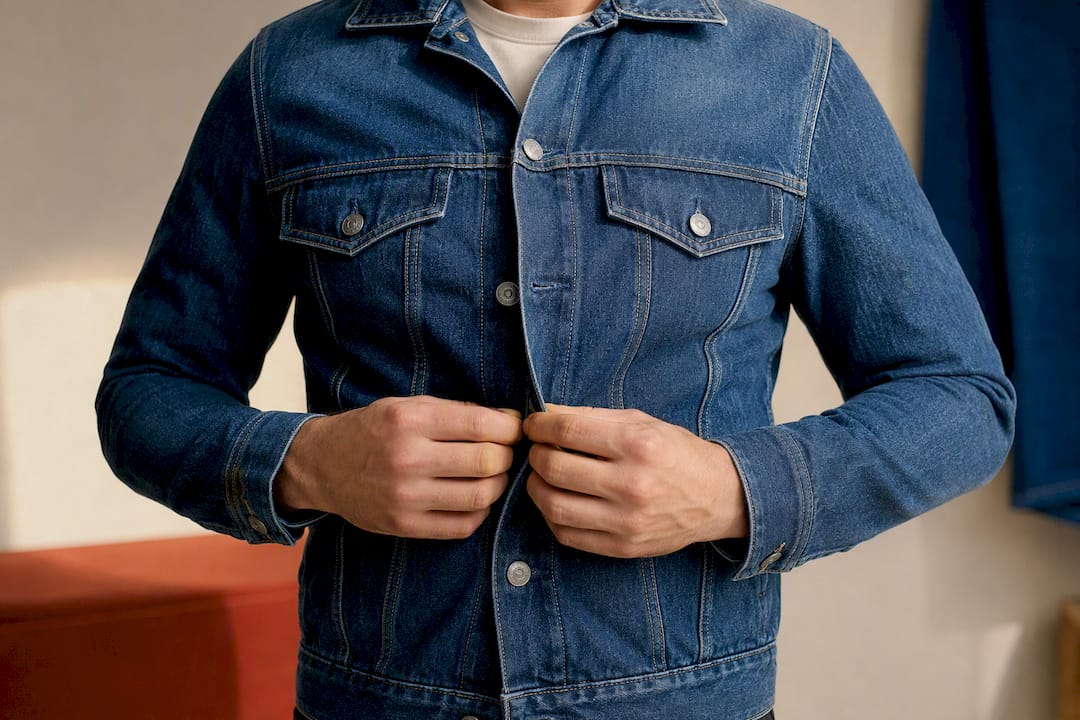
You want a comfortable amount of ease when buttoned, enough that it does not pull tight or show wrinkles radiating out from the buttons, which clearly indicate a jacket is too small. According to Art of Manliness, a well-fitted jacket should hang in straight, clean planes without bunching or pulling anywhere on the body.
A slight taper at the waist is what separates a flattering fit from a boxy one. Denim jackets aren’t meant to be fitted like a blazer, but a small amount of shaping through the midsection keeps the silhouette from reading as a shapeless barrel. Check the back panel construction if you’re unsure: a center seam with curved side panels signals a tailored cut, while straight vertical seams down the sides mean a boxier, more relaxed build.
Signs your torso fit needs attention:
- Buttons straining or gapping when fastened
- Fabric bunching at the sides when you sit down
- A perfectly straight drop with zero waist shaping, which can look oversized rather than intentional
If the shoulders and sleeves fit but the torso runs slightly big, that’s an easy tailoring job. Most alterations shops can take in the side seams for a cleaner line without touching the shoulders or sleeves at all.
Where Should the Hem Land?
Classic denim jacket length hits right at the waist, roughly at or just above the belt line. That’s the proportion most men should default to, since it works with nearly every pant rise and doesn’t disrupt the line of your outfit.
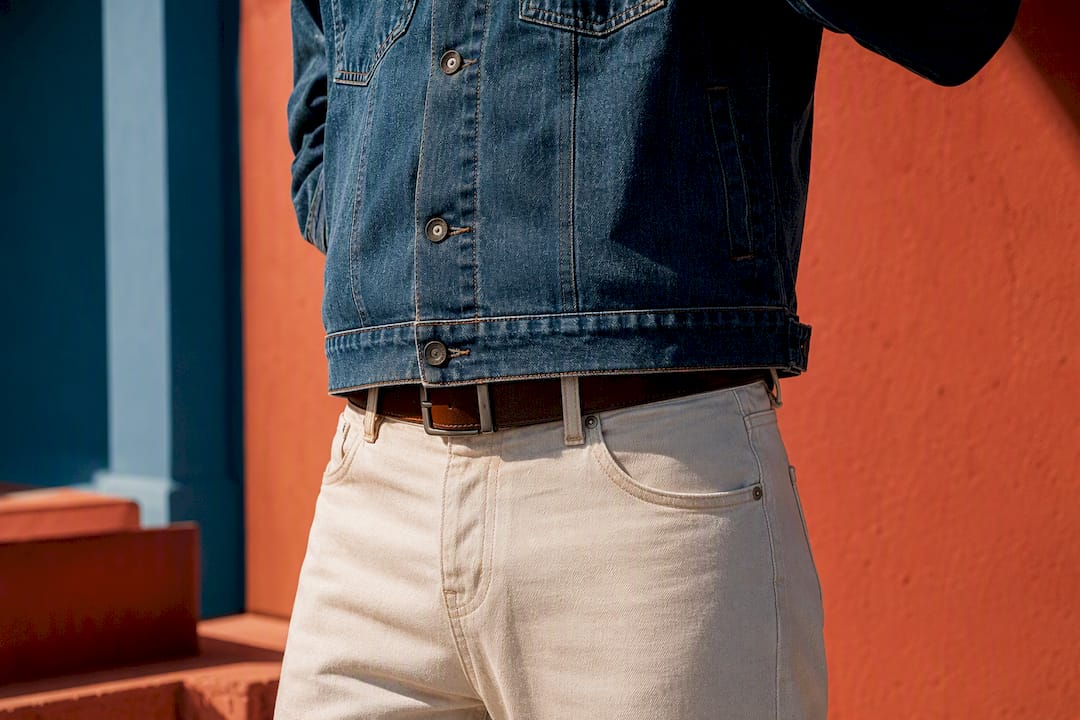
Modern styling has loosened that rule a bit. GQ notes that a jean jacket can fall up to about two inches below the waist for a more contemporary look, as long as it still allows room for a light sweater underneath. That extra length works well if you’re pairing the jacket with higher-rise jeans or want a slightly more relaxed silhouette.
Length affects more than looks. A jacket that’s too long bunches uncomfortably when you sit, and one that’s too short can ride up and expose your lower back when you reach or bend. Consider:
- Hip-length jackets pair best with mid to high-rise pants for a balanced silhouette
- Cropped styles work with high-rise jeans but can look disproportionate with low-rise cuts
- Slightly longer jackets suit taller frames and layer better over hoodies
If you sit for long stretches during your day, test the seated fit before you commit to a length. A jacket that looks great standing can ride up awkwardly the moment you’re behind a desk.
Should You Size Up for Layering?
The rule here is simple: size for the thickest layer you actually plan to wear underneath, not the T-shirt you tried it on with in the store. Denim has almost no stretch, and it won’t meaningfully expand with wear the way a knit will, so buy for the layer you’ll actually put under it most often.
That doesn’t mean sizing up blindly. Here’s how to think through it:
- If you mostly layer over T-shirts or thin button-ups, your standard size is fine. Don’t size up preemptively for a layer you rarely wear.
- If you regularly wear the jacket over a hoodie or flannel, consider sizing up one, or look for a jacket cut with slightly more room through the chest and shoulders from the start.
- If you want a heavier, streetwear-leaning silhouette, a relaxed or oversized cut solves the layering problem without forcing you into a size that fits loose everywhere else, including the shoulders where it matters most.
The tradeoff with simply sizing up is that shoulders and sleeve length scale with the rest of the jacket. Go up a size to fit a hoodie underneath, and you might end up with sleeves too long and shoulder seams sliding toward your biceps. That’s why a genuinely relaxed-fit jacket, cut wider through the body while keeping shoulder placement closer to true, often works better than buying a size up in a slim cut.
Whatever route you choose, run the movement and button tests while wearing your intended layer, not over a bare T-shirt. A jacket that buttons fine over nothing can pull tight the moment you add a hoodie, and you’ll only catch that by testing it loaded up. Our guide on wearing a hoodie under a jacket walks through exactly how much room that combination needs.
How to Measure Your Denim Jacket Fit
You don’t need a tailor’s tape to get this right, just five measurements and a mirror. Take these before you buy or while you’re standing in a fitting room:
- Shoulder span: seam to seam across the back, at the narrowest point of your shoulders
- Sleeve length: from the shoulder seam to your wrist bone, arm relaxed
- Chest: around the fullest part of your chest, jacket unbuttoned
- Waist: around your natural waistline, where the jacket will taper
- Jacket length: from the base of the collar straight down to the hem
These measurements match the checks recommended by Daniel Smart MFG, and comparing them against a brand’s denim jacket size chart before you order online saves you a return.
| Measurement | Where to Check | Target |
|---|---|---|
| Shoulder span | Seam to seam, back panel | Flat, no pulling or excess fabric |
| Sleeve length | Shoulder seam to wrist bone | At or just below wrist bone |
| Chest | Fullest point, buttoned | One fist of ease |
| Jacket length | Collar base to hem | At waist, or up to 2 inches below |
Once it’s on, run the movement checklist: reach forward, cross your arms over your chest, and sit down for a few seconds. Watch for pulling across the back, restricted arm movement, or the hem riding up uncomfortably. If most of it checks out but one area is off, minor tailoring fixes like taking in the waist or hemming the sleeves are typically inexpensive and quick, while shoulder alterations run more and aren’t always worth it compared to trying a different size.
Matching Denim Jacket Fit to Your Style
A slim, precisely fitted trucker jacket and a relaxed, oversized one send completely different signals, and picking the right one depends on where you’re wearing it.
For smart-casual outfits, a trucker jacket fit close to the body works best, buttoned over an oxford shirt with tailored chinos or dark denim. GQ points out that a jean jacket’s versatility comes through most in exactly this kind of pairing, where the fit is what keeps the look sharp instead of sloppy. A darker wash reads slightly dressier here, while lighter washes lean more casual, according to Art of Manliness.
For streetwear-leaning looks, an oversized or boxy cut paired with a hoodie underneath and looser-fit jeans creates the silhouette most guys are actually going for on Instagram right now. Sleeve length still matters here. A jacket that’s oversized through the body but has sleeves running past your wrist looks unfinished rather than intentional.
A few pairing notes worth keeping in mind:
- Cropped jackets pair best with high-rise jeans; the proportions get thrown off with low-rise cuts
- Denim-on-denim works when the washes contrast, not match exactly
- Rolled sleeves and an open front dress a fitted jacket down for casual wear
The precious lamb’s denim jacket outfit ideas show several of these combinations in practice, which is worth a look if you’re trying to visualize how a specific fit translates into a full outfit rather than just a jacket on a hanger.
Thepreciouslamb’s Approach to Denim Jacket Fit
Every jacket Thepreciouslamb designs gets built around the same fit rules covered above: shoulder seams that sit at the natural edge, sleeves that stop at the wrist, and a body cut that hangs clean without bunching. Product pages include sizing details specific to that cut, so you’re not guessing based on a generic size chart that doesn’t match the garment in front of you.
Two examples show how this plays out. The Denim Vintage Washed Heavyweight Jacket follows classic trucker proportions, hitting at the waist with structured shoulders, the exact silhouette this guide recommends for most builds. The Vintage Wash Zip Denim Jacket trades buttons for a zip front and a slightly cleaner line, useful if you want the same fit principles without a button placket to manage.
Before ordering, run your own shoulder and chest measurements against the product page’s size chart. It’s the fastest way to catch a fit issue before the jacket ever ships.
Do Trucker and Bomber Denim Jackets Fit the Same Way?
No, and the difference comes down to what each style is built to do. A trucker jacket, the style most people picture when they think “denim jacket,” is cut straight through the body with a button front and a waist-length hem. It’s designed to be worn open or buttoned, layered or alone, which is why the shoulder-and-chest fit rules in this guide apply to it most directly.
A denim bomber changes the formula. It typically has a fitted waistband, often ribbed or elastic, that cinches in at the hip rather than hanging straight like a trucker. That means the shoulder and sleeve rules still apply exactly the same way, but the torso fit test looks different: instead of checking for straight vertical planes, you’re checking that the ribbed hem sits snug without digging in, and that the jacket doesn’t balloon out above the waistband.
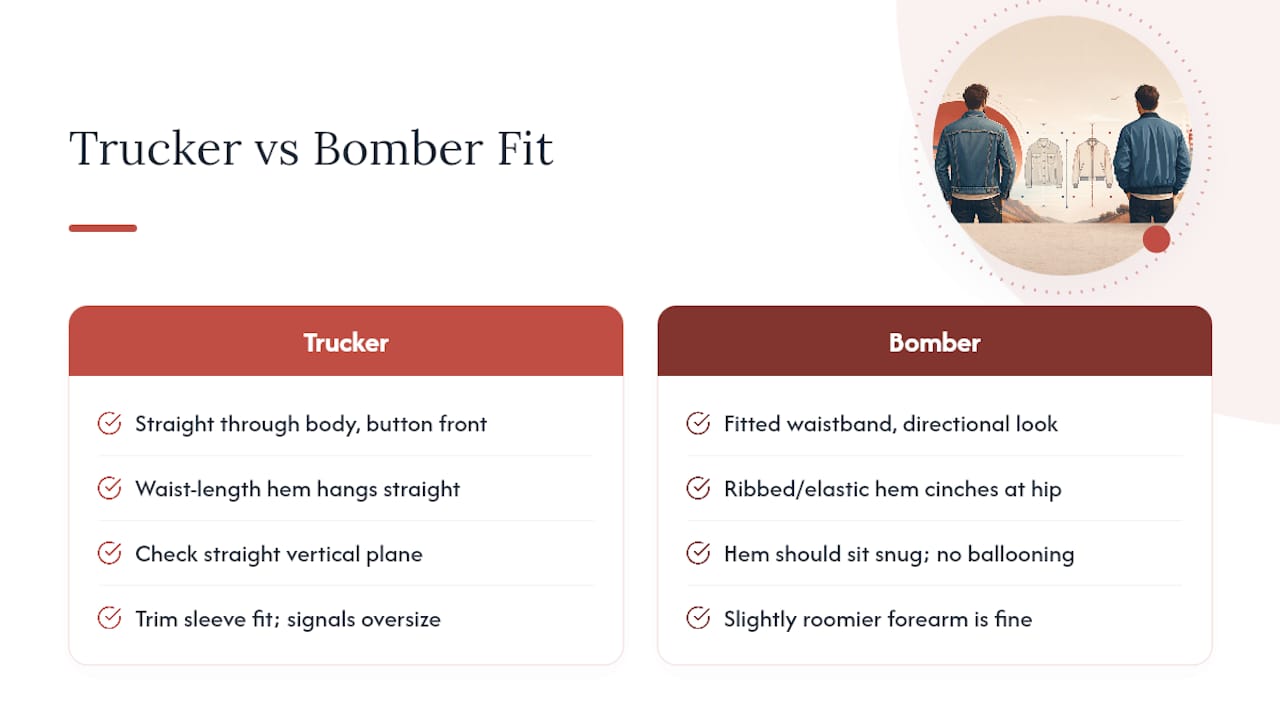
Sleeve width tends to run slightly roomier on bombers to balance the fitted waist, so a jacket that feels slightly loose through the forearm on a bomber might be exactly right, where the same looseness on a trucker would signal a size too big. If you’re deciding between the two, go with a trucker for versatility across casual and smart-casual outfits, and reach for a bomber if you want a more directional, fitted silhouette that pairs naturally with slimmer jeans.
What Actually Matters When You’re Fitting a Denim Jacket
Most fit advice online treats denim jackets like a math problem: measure your chest, cross reference a size chart, done. That misses the part that actually determines whether you’ll wear the jacket or let it sit in the closet, which is how it performs once you move in it.
The shoulder seam gets more attention than it deserves in isolation, and the button test gets less. A jacket can have perfect shoulder placement and still fail you completely if it gapes the moment you sit down or reach for something on a high shelf. Test both together, every time, not as separate checkboxes.
The layering question is where most guys overthink it. You don’t need a jacket that works over every possible outfit. You need one that works over what you’ll actually wear underneath most weeks. Buy for that reality, not for a hypothetical parka-weather scenario that happens twice a winter.
If there’s one thing worth prioritizing first, it’s the movement test over the mirror check. A jacket can look right standing still and still restrict you the moment you’re living in it.
— Joshua
Shop Denim Jackets Built Around These Fit Rules
Reading about ideal shoulder placement and sleeve length only helps if the jacket you buy actually delivers it, and that’s where a lot of denim jackets fall short once they arrive. The precious lamb designs every jacket to the same standard covered in this guide, so the shoulder seams, sleeve length, and torso taper you just learned to check for come standard rather than being a lucky fit.

Two starting points worth trying: the Denim Vintage Washed Heavyweight Jacket gives you the classic trucker proportions this guide recommends for most builds, with structured shoulders and a waist-length hem that works across smart-casual and streetwear outfits alike. If you’d rather skip the button placket, the Vintage Wash Zip Denim Jacket delivers the same fit logic with a cleaner zip front. Each product page lists its own size chart specific to that cut, so measure your shoulders and chest first, then match those numbers against the chart rather than guessing off your usual T-shirt size. Pick your size and check the fit notes on either product page before you check out.
Sources
- How to Wear a Denim Jacket | The Art of Manliness
- How to Style a Jean Jacket: 4 Foolproof Ways to Wear the Ultimate Layering Piece | GQ
- How a Denim Jacket Should Fit a Man — The Essential Man