
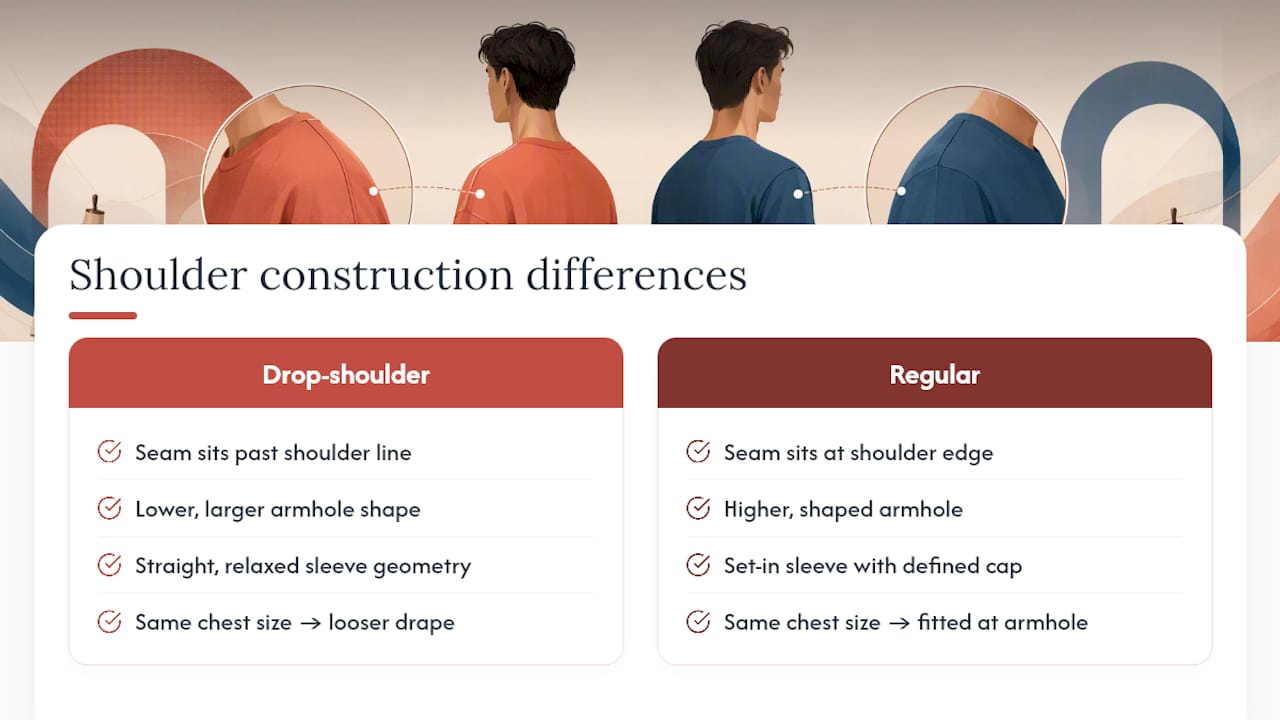
Drop shoulder means the seam sits below your natural shoulder point by a measurable amount, which gives the whole garment a boxy, relaxed drape. Regular, or set-in, shoulder puts the seam right at that natural point, which tapers the sleeve and keeps a structured line. Pick drop shoulder when you want deliberate oversized volume; pick regular when you want a tailored silhouette that follows your body.
TL;DR:
- Drop shoulder garments have seams placed 1 to 4 inches below the natural shoulder point, creating a boxier, oversized silhouette ideal for casual streetwear.
- True drop shoulder pieces feature a lowered armhole, wider chest measurements, and a horizontal seam line, distinguishing them from regular set-in shoulder styles.
- Fabric weight influences the appearance of drop shoulders, with midweight and heavyweight fabrics maintaining a crisp silhouette and lighter fabrics appearing droopier.
- Body shape matters; drop shoulder flatters sloped shoulders and pear shapes, while broad shoulders may look better with regular set-in sleeves for a balanced look.
- Confirm garment construction by checking shoulder-drop measurements, armhole details, and product descriptions to avoid sizing errors and unwanted shoulder styles.
Table of Contents
- What Do Drop Shoulder and Regular Shoulder Actually Mean?
- How Do You Measure the Difference Between the Two Styles?
- Which Shoulder Style Fits Your Body Best?
- Does Fabric Weight Change How a Drop Shoulder Looks?
- How Do You Style Drop Shoulder and Regular Shoulder Pieces?
- What a Fit-First Shopping Checklist Looks Like
- Why Most Fit Advice Skips the Real Problem
- Where ThePreciousLamb’s Fits Land on This Spectrum
- Sources
- FAQ
What Do Drop Shoulder and Regular Shoulder Actually Mean?
A set-in shoulder follows the curve of your actual shoulder. The sleeve seam sits right where your arm meets your torso, so the fabric hugs the deltoid and the sleeve cap has a rounded shape that lets your arm move without pulling the whole shirt with it. That’s the construction behind most dress shirts, fitted tees, and tailored jackets.
A drop shoulder places the seam below that natural point, commonly 1 to 4 inches down the arm. The lower the drop, the boxier the garment reads, and the sleeve tends to sit flatter against the body instead of curving around it. This is the construction behind most streetwear hoodies, oversized tees, and boxy sweatshirts.
Spotting each one in photos or on a size chart comes down to a few visual cues:
- Seam location on a flat lay: if the seam runs straight across near the collar rather than curving down toward the armpit, that’s drop shoulder.
- Sleeve angle on a model: set-in sleeves angle downward from the shoulder; drop shoulders create a more horizontal line across the upper chest.
- Armhole depth: drop-shoulder garments almost always have a noticeably larger, looser armhole.
- Product copy: listings that say “boxy,” “oversized,” or “relaxed fit” are usually drop shoulder by design, not accident.
How Do You Measure the Difference Between the Two Styles?
Comparing two garments side by side means checking the same four points every time, because a size chart alone won’t tell you which construction you’re getting.
- Shoulder drop. Measure from the natural shoulder bone straight down to where the sleeve seam actually sits. Anything past roughly 2 inches usually reads as intentional drop shoulder rather than a slightly loose regular fit.
- Chest half-width. Lay the garment flat and measure armpit to armpit. Drop-shoulder pieces run wider here relative to the shoulder seam because the extra room is built into the pattern, not just added at the sides.
- Sleeve attachment point. Look at where the sleeve panel actually joins the body panel. A lowered attachment point is the single clearest signal you’re looking at a true drop-shoulder pattern.
- Hem width. Compare hem width to chest width. A boxy drop-shoulder shirt often keeps a similar width top to bottom, while a regular fit tapers in at the waist.
This is also why ordering a size up in a regular-fit pattern won’t give you a drop-shoulder look. A larger regular shirt adds width evenly across a pattern still cut for a natural shoulder line, so the seam stays roughly in place and the sleeve still curves. A drop-shoulder pattern uses entirely different cutting panels and a lowered, often larger armhole from the start. One is a sizing decision; the other is a design decision.
Which Shoulder Style Fits Your Body Best?
Body shape determines whether a lowered seam flatters you or fights you. A few patterns hold up consistently:
- Sloped shoulders benefit from drop shoulder, since the lowered seam visually squares off and widens the shoulder line, balancing a shoulder that naturally angles down.
- Broad or already square shoulders often look top-heavy in drop shoulder. A regular, set-in sleeve keeps the shoulder line close to the body instead of extending it further outward.
- Pear shapes can use drop shoulder up top to balance wider hips, especially paired with a straighter pant leg.
- Rectangle shapes can go either way, but a slightly cropped or higher-hem drop-shoulder piece adds visual shape that a straight regular fit won’t.
- Inverted triangles generally do better in regular shoulder, since drop shoulder adds width exactly where they already carry the most volume.
On sizing: if a brand’s chart lists a dedicated drop-shoulder or oversized fit, order your true size. That garment was already patterned with the extra room built in. Only size up if you’re trying to force an oversized look out of a regular-fit pattern, and know going in that the result will look loose rather than intentionally boxy.
Pro Tip: Before buying, check whether the shoulder drop is actually listed in inches on the size chart. If it isn’t, look for a flat-lay photo showing the seam placement, or message the seller. Guessing from the model photo alone is how most oversized-fit returns happen.
Does Fabric Weight Change How a Drop Shoulder Looks?
Fabric choice decides whether a drop shoulder looks designed or just sloppy. Lighter knits tend to collapse at the lowered seam, pulling the shoulder line down into a droopy shape instead of holding a clean edge.
Midweight to heavyweight fabrics, roughly 180 GSM and above depending on the fiber, hold their structure at that lowered seam and keep the silhouette looking intentional rather than accidental. This is a big part of why heavier fleece and French terry read as “on purpose” boxy while a thin cotton tee in the same cut can look like it just doesn’t fit.
A few construction details worth checking:
- Armhole finish. A reinforced or bound armhole holds its shape better under the extra strain of a wider opening.
- Sleeve cap shape. Drop-shoulder sleeves are cut flatter than set-in sleeves; a flat cap with clean stitching signals a purpose-built pattern.
- Knit vs. woven. Knits drape more and soften the boxy line; wovens hold a crisper, more architectural shape at the same drop measurement.
Denim and heavier twill fall into this same logic. A heavyweight denim jacket built with the right shoulder drop holds its structure far better than a lighter fabric cut the same way.
How Do You Style Drop Shoulder and Regular Shoulder Pieces?
Balancing proportions is most of what makes an oversized top look styled rather than accidental.
- Pair drop-shoulder tops with straight-leg or slightly tapered pants. Ultra-skinny bottoms exaggerate the volume up top instead of balancing it.
- Half-tuck the front. This breaks up a boxy silhouette and shows there’s a waistline underneath all that fabric.
- Keep outerwear cropped or hip-length over a drop-shoulder piece. A long coat over an already-oversized top doubles the bulk.
- Layer regular-shoulder pieces under structured jackets. The clean shoulder line plays well with blazers, tailored coats, and anything meant to look put-together rather than relaxed.
- Use accessories to reset proportion. A fitted cap or a slim belt bag reads as a small, deliberate contrast against a bigger silhouette, whichever shoulder style you’re wearing.
Streetwear leans on drop shoulder specifically because the boxy cut translates well across different body types when the fabric weight is right, which is part of why it’s become the default silhouette for hoodies and graphic tees.
What a Fit-First Shopping Checklist Looks Like
A fit and construction expert named Joshua put together a denim jacket fit guide around this exact problem: shoppers guessing at silhouette instead of checking the numbers.
Before adding anything to your cart, run through this short list:
- Does the size chart list a shoulder-drop measurement, or only chest and length?
- Does a flat-lay photo show where the sleeve seam actually sits?
- Is the chest half-width noticeably wider than the shoulder seam width?
- Does the product description use words like “boxy,” “relaxed,” or “oversized fit” specifically?
- If none of that’s clear, request measurements or a sample before you buy in bulk or for a size you can’t easily return.
A boxy fleece hoodie listed with a clear shoulder-drop spec and flat-lay photos is a good real-world example of a product page doing this correctly, letting you confirm the silhouette before it ever ships.
Why Most Fit Advice Skips the Real Problem
Most fit guides treat drop shoulder and regular shoulder as a style preference, like choosing a color. That’s backwards. The real decision point is pattern geometry, not taste. A shirt built on a drop-shoulder pattern and a regular shirt ordered a size up can list similar chest measurements and still look completely different on your body, because the seam location and armhole shape were never the same to begin with.
The advice that actually holds up is boring but reliable: check the shoulder-drop number, check the armhole, check the fabric weight, and stop trusting model photos alone. Sloped shoulders and pear shapes have real, specific reasons to lean toward drop shoulder. Broad shoulders have real reasons to stay with a set-in sleeve. None of that requires guesswork if the product page gives you the actual measurements.
If there’s one habit worth building, it’s this: treat the size chart as the primary source and the photo as a secondary check, not the other way around.
— Joshua
Where ThePreciousLamb’s Fits Land on This Spectrum
Some boxier pieces, like the Contrast-Stitched Boxy Fleece Zip Hoodie and the Snow Washed Distressed Panel Pocket Hoodie, use genuine drop-shoulder patterns rather than a regular cut sized up. Both sit in a midweight fleece meant to hold that lowered seam cleanly instead of sagging into a sloppy line.

If you’re after a more structured, set-in shoulder for layering under a jacket or wearing somewhere dressier, the denim pieces built with a tailored shoulder line, like the Denim Vintage Washed Heavyweight Jacket, sit closer to that regular-fit end of the spectrum. Before you buy, check the shoulder-drop number on the product page and compare chest width to hem width the same way you would with any drop-shoulder garment. If the specs aren’t listed clearly enough for you to picture the silhouette, that’s worth flagging before checkout, not after the return window closes. Browse the Contrast Striped Lapel Collar Sweatshirt for a middle-ground option if you want some drape without going fully boxy, and place your order once the measurements match what you’re actually looking for.
Sources
The Sew Guide breakdown of drop-shoulder style explains seam placement clearly. The GOODTEX fit and sourcing guide covers GSM and pattern specifics. The BulkPlainTshirt fit-mistake case study shows what goes wrong when sizing up substitutes for a real pattern change. For knitwear specifically, Thepreciouslamb’s sweatshirt vs. sweater guide and Skoki Maev’s organic cotton sweater collection offer useful comparison points on fabric and shoulder construction.
- Oversized & Drop-Shoulder T-Shirt Guide | Fit, Specs & Sourcing — GOODTEX
- Drop Shoulder vs Regular Shoulder: The Oversized T-Shirt Fit Mistake That Cost 300 Pieces | BulkPlainTshirt
- Drop shoulder style in fashion — Sew Guide
- Understanding shoulder seams: Fit, proportion & style — Jo-Lynne Shane
FAQ
Who should wear a drop shoulder?
Drop shoulder tends to flatter sloped shoulders and pear shapes since the lowered seam widens and squares off the shoulder line. People with already broad or square shoulders often get a more balanced look from a regular, set-in sleeve instead.
Why are dropped shoulders so popular right now?
The construction became a streetwear staple because the boxy cut suits a wide range of body types when paired with the right fabric weight, making it a reliable, forgiving fit for unisex and casual collections.
Does drop shoulder mean the same thing as oversized?
Not exactly. Drop shoulder describes where the seam sits; oversized describes overall volume. A garment can have a mild shoulder drop without being dramatically oversized, though most oversized streetwear pieces do use a drop-shoulder pattern to get that boxy silhouette.
How do you avoid ending up with an unwanted drop shoulder?
Check the shoulder-drop measurement and armhole size on the product page before buying, and compare chest half-width to hem width. If a listing doesn’t specify the construction, request a flat-lay photo or exact measurements rather than assuming a regular fit sized up will get you the same look.