
Neither fiber wins outright: wool insulates better wet or worn static, fleece insulates better dry and active. Garments of similar weight and construction often trap heat at nearly the same rate, so the fiber name on the tag matters less than the loft, thickness, and knit behind it. The rest of this guide shows you how to read the specs (GSM, thermal resistance) and match the fabric to the actual conditions you’ll be in.
TL;DR:
- Warmth in fleece and wool depends mainly on loft and construction, with similar garments often providing comparable insulation despite fiber differences.
- Wool maintains insulation better when wet, while fleece’s insulation drops significantly upon saturation, affecting performance in damp conditions.
- Wool dries more slowly than fleece and retains heat when soaked, making it more suitable for prolonged wet or damp environments.
- Fleece offers better breathability and quicker moisture venting during intense activity, whereas wool absorbs moisture and resists odor over multiple days.
- Comparison of GSM and fabric construction provides a better guide to warmth than fiber type alone, emphasizing matching garments to actual conditions over marketing labels.
Table of Contents
- How Fleece and Wool Warmth Actually Work
- Is Wool Warmer Than Fleece in Direct Testing?
- What Happens to Fleece and Wool Warmth When They Get Wet
- Which Fabric Breathes Better and Resists Odor?
- Reading GSM: Weight, Packability, and Warmth-Per-Weight
- Cost, Care, and Environmental Tradeoffs
- Which Should You Choose: A Scenario-Based Guide
- Does the Type of Wool Change How Warm It Is?
- Not All Fleece Is the Same, Either
- How People Used Fleece and Wool Before Technical Gear Existed
- Why Knit and Weave Matter as Much as the Fiber
- Building a Layering System With Fleece and Wool
- A Publisher’s Take on Choosing Between Fleece and Wool
- Find Fleece Built for How You Actually Use It
- Sources
How Fleece and Wool Warmth Actually Work
Warmth in either fabric comes from the same mechanism: trapped air. Wool fiber has a natural crimp, a wave pattern that creates thousands of tiny air pockets per garment. Fleece is a knit or brushed synthetic that gets teased into a pile, which does the same job mechanically. In both cases, the still air between fibers, not the fiber itself, is what slows heat loss from your body.
That’s why loft matters more than material when you’re comparing two jackets on a rack. A thin, dense wool sweater can trap less air than a thick, fluffy fleece, and end up less warm, even though wool has a reputation as the “warmer” fiber.
Two numbers help you compare garments objectively:
- GSM (grams per square meter) measures fabric weight and density. Higher GSM generally means more material and often more warmth, though it isn’t a perfect proxy for loft.
- Thermal resistance (R-value or clo) measures how well a fabric resists heat flow. This is the closer measure to “how warm will this actually feel.”
Construction changes both numbers dramatically. A brushed, high-pile fleece traps more air than a flat-knit fleece of the same weight. A tightly spun merino base layer behaves differently than a loosely knit lambswool sweater. Field-test reviews on specific garments consistently find that pile height, two-ply builds, and liner fabrics swing perceived warmth more than the raw fiber choice does. When you’re shopping, checking a GSM listing on the product page tells you more than the words “fleece” or “wool” alone.
Is Wool Warmer Than Fleece in Direct Testing?
Not by much, when the samples are matched for thickness. Lab measurements using the Alambeta thermal testing method found a wool sample measuring 1.32mm thick had a thermal resistance around 0.0488, while a Polartec polyester fleece sample at 1.522mm measured around 0.043, according to comparative fabric testing. Wool edged ahead in that specific pairing, but the fleece sample was also thinner. Match the thickness and the gap narrows further.
The takeaway from lab data: thermal resistance between similarly built fleece and wool is close enough that construction and loft, not fiber identity, decide the winner in most real garments.
This matters because a lot of shopping decisions get made on fiber reputation alone. Someone assumes a wool sweater will out-warm a fleece hoodie simply because wool “sounds” warmer, then buys a thin merino layer that’s outmatched by a heavyweight fleece hanging two racks over. The measurement gap between fibers is small; the gap between a 200 GSM fleece and a 400 GSM fleece is not.
Where the two fabrics genuinely diverge isn’t dry insulation. It’s what happens when either one gets wet or when the activity level changes. A wool sweater sitting still in a cold, damp tent will usually out-warm a synthetic fleece of the same weight, because wool continues to trap heat even saturated. A fleece jacket on a fast, sweaty climb will usually feel more comfortable than a wool one, because it vents heat and dries faster once you stop moving. Neither of those outcomes shows up in a static lab thermal-resistance number. That’s the practical limit of R-value comparisons: they measure a garment sitting still and dry, not a garment on your back doing something.
What Happens to Fleece and Wool Warmth When They Get Wet
This is where the two fabrics really split apart. Merino wool retains a large share of its insulating power even soaked through, commonly cited as the majority of dry performance, according to comparative testing on wet insulation. Synthetic fleece behaves differently: once saturated, it can drop to a small fraction of its dry insulating value, because water fills the air pockets that made it warm in the first place.
Drying time tells the other half of the story. Fleece typically dries in a few hours, even in the field, while wool often needs several hours to fully dry. That tradeoff explains why backpackers debate this endlessly: wool stays warmer wet, but stays wet longer.
Evaporative cooling makes the wet-fleece problem worse than it sounds. As water evaporates off a soaked fleece, it pulls heat from your skin, which is exactly the wrong direction on a cold, wet day.
Ways to manage this in practice:
- Layer a waterproof or windproof shell over fleece to block direct saturation.
- Pack a dry spare base layer for camp, especially on wet multi-day trips.
- Put wool closer to skin on damp trips where it may get soaked from sweat or rain; save fleece for drier, active stretches.
Pro Tip: If you’re choosing one insulating layer for a trip with a real chance of rain and no way to dry gear overnight, wool’s wet-insulation retention is the safer bet, even if it means carrying a slightly heavier garment.
Which Fabric Breathes Better and Resists Odor?
Fleece and wool manage sweat in almost opposite ways. Fleece is largely a vent: sweat vapor passes through the open knit structure and escapes, which is why fleece feels fast and light during hard efforts. Wool works more like a sponge with a memory. It absorbs moisture into the fiber itself and releases it gradually, which keeps the fabric surface feeling drier against skin even while it’s holding water internally.
That absorb-and-release trait connects directly to wool’s other advantage: odor. Wool fiber has natural antimicrobial properties that resist the bacteria responsible for body odor, letting a merino layer go multiple days of wear, often cited as lasting several days depending on activity intensity, per long-form comparisons of the two fabrics. Fleece has no equivalent property and picks up odor fast under sustained sweat.
Simple rule for picking between them here:
- Multi-day trip with no laundry access, or you hate packing extra layers: lean wool.
- Single-day, high-output activity where fast venting matters more than day-three freshness: lean fleece.
Both outperform cotton by a wide margin on this front, according to Orvis’s comparison of cold-weather fabrics, and understanding how moisture wicking actually works helps explain why sweat management, not just warmth, drives a lot of layering decisions.
Reading GSM: Weight, Packability, and Warmth-Per-Weight
Warmth-per-weight is the real metric that matters when you’re stuffing a layer into a pack. A garment can be warm and still be a poor travel companion if it’s dense and heavy rather than lofted and light. Fluffier, higher-loft fabrics trap more air per gram than dense, tightly knit ones, which is why a compressible fleece or a lofted wool sweater often beats a heavy, flat-knit garment of similar warmth.
Rough GSM guidelines for shopping:
- Lightweight base layers: roughly 150 to 200 GSM, for active layering under a shell.
- Midweight fleece or wool: roughly 200 to 300 GSM, the most common range for everyday hoodies and sweaters.
- Heavyweight insulating layers: 300 GSM and up, built for static cold rather than movement.
If you’re packing for a trip where every ounce counts, prioritize loft and compressibility over raw GSM. If you’re dressing for standing around in the cold, heavier and denser wins.
Cost, Care, and Environmental Tradeoffs
Fleece is almost always the cheaper option up front, and it’s easier to live with day to day. Most fleece garments go straight into a washing machine on a normal cycle, according to Orvis’s care comparison, while wool typically needs gentler washing or hand care to avoid shrinking and felting.
Fleece’s weak point over time is pilling. Repeated washing and wear breaks down the pile, which flattens the loft that made it warm in the first place, so a well used fleece often loses noticeable insulation after a couple of seasons. Wool, cared for properly, tends to hold its shape and warmth much longer, which is part of why vintage wool sweaters still perform decades later.
Environmentally, each fabric carries its own cost:
- Polyester fleece sheds microplastic fibers into wastewater with every wash.
- Wool production carries land and water impacts tied to raising sheep, along with sourcing and animal welfare questions.
- Neither fabric is environmentally free; the tradeoff is between synthetic microfiber pollution and agricultural footprint.
If durability and long-term cost matter more than upfront price, wool often wins on lifespan. For a deeper look at fabric sourcing tradeoffs, see this guide to recycled polyester versus cotton, and for keeping a fleece garment lofted longer, a proper hoodie care routine slows the pilling problem considerably.
Which Should You Choose: A Scenario-Based Guide
Match the fabric to the activity and the weather, not to fiber reputation. Here’s how that plays out in the situations people actually ask about:
- High-output dry hike: Fleece. It vents sweat fast and won’t overheat you on a climb. Red flag: sudden rain with no shell means you’ll chill fast once you stop moving.
- Rainy multi-day backpacking trip: Merino wool. It keeps insulating even soaked and resists odor across days without laundry. Red flag: it dries slowly, so pack a dry sleep layer.
- Everyday urban cold, commuting or errands: Either works; pick fleece for easy care, wool for a dressier look. Red flag: thin fashion fleece with low GSM won’t hold up in real wind.
- Camp or static cold (fishing, hunting stands, photography): Wool. Low output means you need a fabric that holds heat without you generating much of your own. Red flag: fleece alone in still, damp cold underperforms once sweat cools.
- Multi-sport travel where pack weight matters: A lofted, higher-GSM fleece for warmth-per-weight, layered under a shell. Red flag: overpacking a heavy wool sweater “just in case” wastes pack space.
| Scenario | Best pick | Why |
|---|---|---|
| High-output dry hike | Fleece | Vents sweat, dries fast |
| Rainy multi-day trip | Merino wool | Retains warmth wet |
| Everyday urban wear | Either | Comparable warmth, care differs |
| Static cold / camp | Wool | Insulates without movement |
| Weight-sensitive travel | Lofted fleece | Better warmth-per-weight |
Does the Type of Wool Change How Warm It Is?
Not all wool performs the same, and the grade matters as much as the fiber family. Merino wool, sourced from merino sheep, has fine fibers (typically under 24 microns) that trap air efficiently while staying soft enough to wear against skin, which is why it dominates the base-layer and midweight sweater market.
Coarser wool, often from breeds raised primarily for meat rather than fiber quality, has thicker strands that feel scratchier and trap air less efficiently per gram. It’s warm, but usually heavier and less comfortable next to skin, which pushes it toward outerwear and blankets rather than base layers.
Lambswool sits in between. It comes from a sheep’s first shearing, and the fiber tends to be softer and finer than adult fleece from the same animal, though generally coarser than merino. It’s a common choice for sweaters that need drape and warmth without the cost of merino.
Blended wool, mixing merino with nylon or synthetic fibers, trades a small amount of pure insulation for added durability and faster drying. That tradeoff matters if you’re picking a sweater for daily wear rather than a dedicated technical layer. The grade on the tag is a genuine warmth signal, not marketing language, and it’s worth checking before assuming “wool” means one consistent performance level.
Not All Fleece Is the Same, Either
Fleece varies just as much as wool, and the differences show up in both warmth and durability. Polyester fleece is the dominant type, made by knitting fine polyester yarn and then brushing the surface to raise a pile. Within that category, weight and pile height do most of the work: a 100 weight fleece is thin and meant for active layering, a 200 weight sits in the middle as an everyday hoodie or midlayer fabric, and 300 weight is a heavier, standalone insulating piece.
Microfleece is a lighter, tighter-knit version often used for base layers and linings, prioritizing softness and low bulk over raw warmth. Sherpa fleece, brushed heavily on one side to mimic a shearling look, adds warmth and texture but usually weighs more for the same insulating value as a standard brushed fleece.
Some fleece blends synthetic fiber with a small percentage of recycled material or spandex for stretch, which changes drape and fit without changing the core insulation math much. A curated fleece hoodie lineup shows how weight and pile height translate into real product choices, since specs on a hang tag rarely tell the whole story on their own.
How People Used Fleece and Wool Before Technical Gear Existed
Wool has insulated people for thousands of years, long before synthetic fiber existed at all. Herding cultures across Europe, Central Asia, and the Andes built entire clothing traditions around raw sheep’s wool, felting it into dense mats or spinning and knitting it into sweaters that stayed warm through brutal winters. Sailors and fishermen in the North Atlantic relied on tightly knit wool sweaters, sometimes treated with natural oils, precisely because wool kept insulating even soaked by sea spray.
Fleece has a much shorter history. Malden Mills (later rebranded Polartec) developed the modern synthetic fleece fabric in the 1980s, aiming to build something lighter and faster drying than wool for outdoor use. It caught on quickly with hikers and climbers who needed a layer that wouldn’t turn into dead weight after a rainstorm. In under two decades, fleece went from a niche outdoor fabric to a mainstream casual staple, which is part of why it now shows up as much in hoodies and everyday sweatshirts as in technical layering systems.
The historical split maps almost exactly onto the modern one: wool for enduring conditions where drying isn’t an option, fleece for speed and convenience once fast drying became possible to manufacture.
Why Knit and Weave Matter as Much as the Fiber
Two garments made from the same fiber can perform completely differently based on how that fiber is constructed. A flat, tight knit traps less air than a brushed or looped pile, which is why a thin wool dress sweater and a chunky cable knit sweater made from identical yarn can feel dramatically different in the cold.
Brushing is the key process for fleece. Manufacturers run the fabric surface through a brushing machine that pulls fibers up into a raised pile, creating the air-trapping structure that makes fleece warm for its weight. A fleece that skips heavy brushing, common in cheaper, thinner fashion pieces, ends up closer to a plain knit in performance despite looking similar on a hanger.
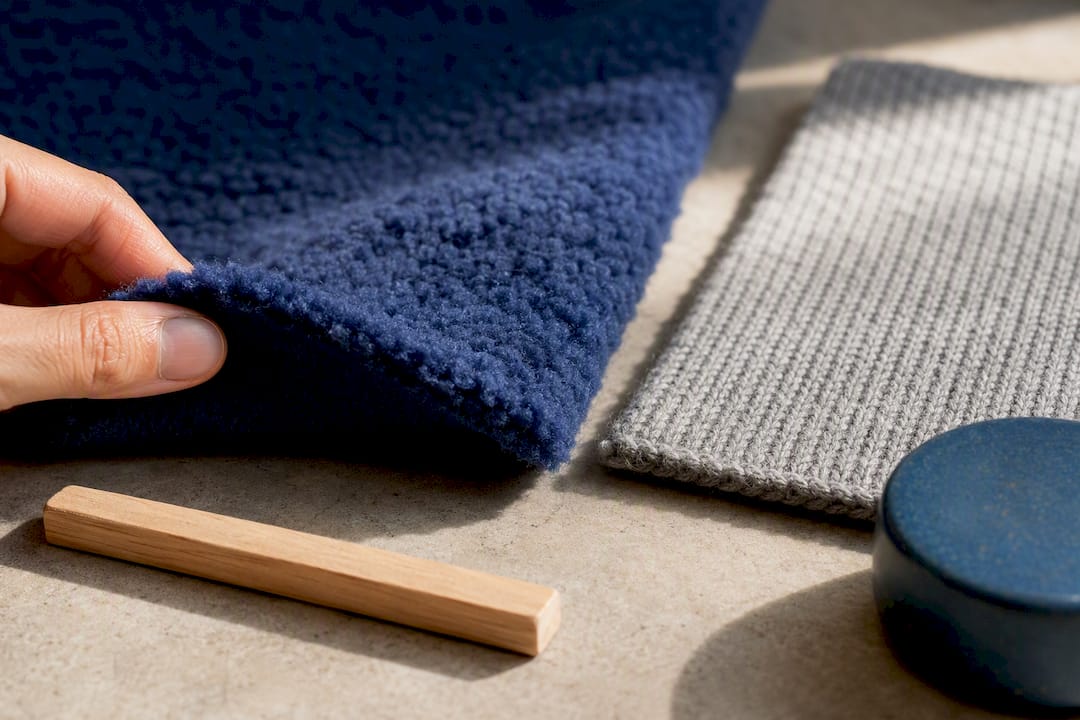
For wool, the spinning and knitting method changes performance just as much. Loosely spun, thick-gauge knits (like a traditional fisherman’s sweater) trap more air than tightly spun, fine-gauge knits (like a merino base layer), even using the same wool grade. Woven wool, as opposed to knit, produces a denser, less lofted fabric typically used for coats and suiting rather than base insulation.
This is the real reason two products in the “midweight fleece” or “wool sweater” category can differ noticeably in warmth. Checking pile depth, knit tightness, and GSM together gives a far more accurate warmth read than the fiber label alone.
Building a Layering System With Fleece and Wool
The strongest cold-weather systems use both fabrics for what each does best rather than picking one exclusively. A common structure: a wool or merino base layer against skin for odor control and wet-weather reliability, a fleece midlayer for active insulation and fast venting, and a waterproof or windproof shell on top to block the elements from soaking either one.
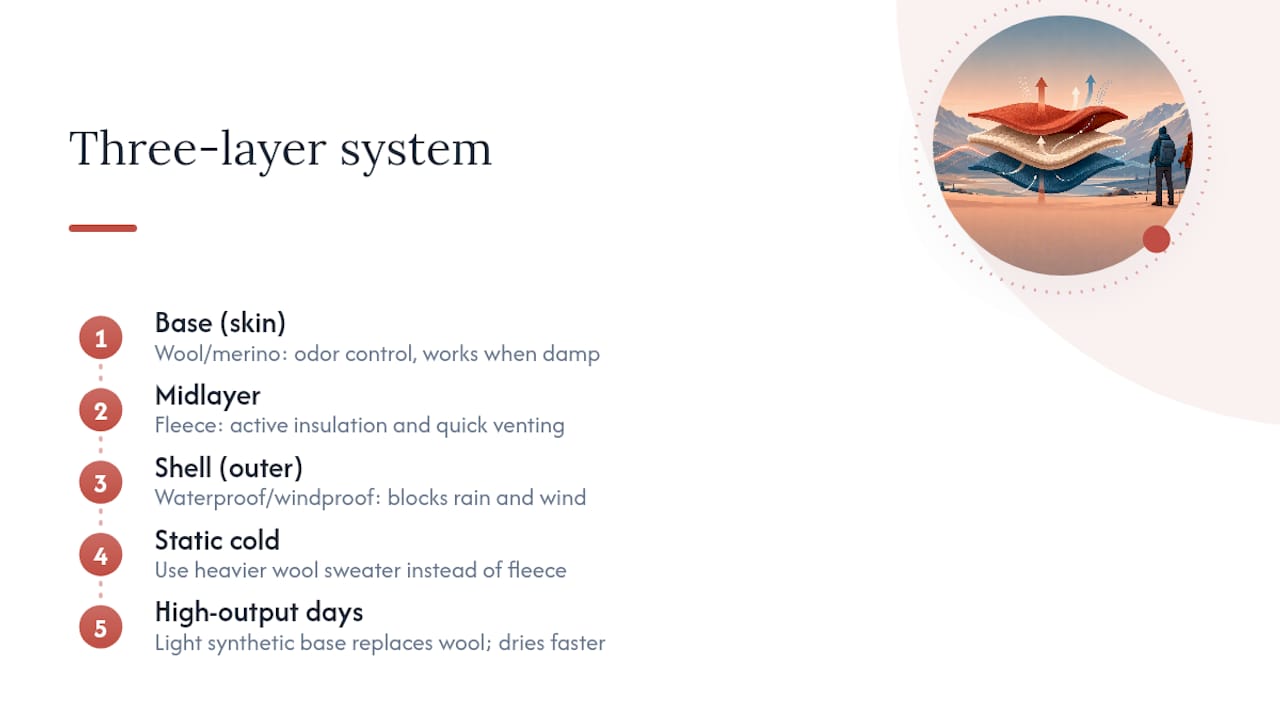
This order works because it stacks strengths instead of canceling them out. Wool against skin manages sweat and stays functional if it gets damp from perspiration. Fleece over that adds bulk insulation without trapping moisture against your body, since it isn’t in direct contact with sweat. The shell then protects both layers from rain and wind, the one weakness fleece has on its own.
For static, cold-but-dry conditions, swapping the fleece midlayer for a heavier wool sweater can add more raw warmth per layer, since wool traps air effectively even without much brushing. For high-output days, dropping the wool base layer for a lightweight synthetic wicking layer under fleece often feels more comfortable, since synthetics dry faster than wool during heavy, sustained sweating.
There’s no universal three-layer formula that works for every trip. The activity level and moisture exposure should decide which fabric sits where, which is really the same rule that governs the fleece versus wool decision in the first place: match the fabric to the conditions, not to a fixed system.
A Publisher’s Take on Choosing Between Fleece and Wool
Most warmth debates online treat this as a contest with a single winner, and that framing does readers a disservice. The lab numbers back this up: thermal resistance between matched-thickness fleece and wool lands close enough that the fiber name barely matters next to construction and loft.
Product specs are written with that nuance in mind. When you see a GSM figure, fiber content, or intended-use note on a product page, it’s there so you can match the garment to your actual conditions rather than trust a marketing label. A fleece hoodie built for casual daily wear doesn’t need to compete with a technical wool base layer built for wet backcountry trips. They solve different problems.
Read specs the way you’d read a nutrition label: GSM tells you weight and likely warmth, fiber content tells you wet-weather behavior and care needs, and intended-use notes tell you whether a piece is meant for daily wear or harder conditions.
— Joshua
Find Fleece Built for How You Actually Use It
Most warmth guides leave you comparing lab numbers with no easy way to translate that into an actual purchase. Fleece pieces are designed with loft and construction details to help you understand the spec sheet, so you’re not guessing at pile weight or GSM from a product photo.

The Vintage Washed Cropped Fleece Hoodie fits the everyday urban and light outdoor scenario this guide keeps circling back to: enough loft for real cold-weather comfort, brushed construction for warmth-per-weight, and an easy care routine that won’t punish you for tossing it in the wash. If you want a boxier fit with the same fleece performance, the Contrast-Stitched Boxy Fleece Zip Hoodie gives you a looser layering silhouette that works well over a base layer on colder days.
Check the product pages for weight and fiber details before you buy, and pick the piece that matches your actual conditions rather than the one that just looks warmest on a hanger.
Sources
- Fleece vs Wool: Warmth, Protection, Care, and More – Decide Outside
- Merino wool vs fleece thermals: which keeps you warmer? - Merino And Beyond
- Fleece vs. Wool: Which Offers the Best Protection From the Elements? - Orvis News