
GSM stands for grams per square meter, the industry measure of how heavy a fabric is. For most everyday t-shirts, a practical starting range is 150 to 200 GSM, with lighter weights for summer and higher weights for a sturdier, more structured feel. The right number still depends on fiber, knit, and how the shirt will be printed, so the smartest move before ordering in bulk is to test a physical sample first.
TL;DR:
- Different fabric test standards can result in varying GSM measurements, so full-width sampling provides more reliable, consistent data than spot-checks.
- Choosing the right GSM depends on intended use, silhouette, and season, with 150-200 GSM suited for most year-round casual wear.
- GSM alone does not determine fabric quality, which is also influenced by fiber content, knit type, finish, and construction details.
- Heavier GSM fabrics (above 260) offer opacity and structure but can feel stiff, making weight selection crucial for desired drape and fit.
- Testing decoration methods on actual fabric samples before bulk production helps prevent puckering, bleeding, or stiff prints, especially for denser designs.
Table of Contents
- What Is GSM in Clothing and How Is It Measured?
- What Is a Good GSM for a T-Shirt? A Quick Reference Chart
- How Does GSM Affect Screen Printing, DTG, and Embroidery?
- Which GSM Fits Your Style, Climate, and Silhouette?
- Does GSM Alone Tell You Enough About Quality?
- A Quick Checklist Before You Buy Blanks or Finished Tees
- Why GSM Shapes Every Design Decision We Make
- Find Your Fit: Everyday and Boxy Tees Built Around the Right Weight
- Standards and Guides Behind This Article
- Sources
- FAQ
What Is GSM in Clothing and How Is It Measured?
GSM measures the mass of one square meter of fabric. Weigh a meter-square patch of cloth in grams, and that number is your GSM. Higher GSM means a denser, heavier textile; lower GSM means something thinner and lighter. It sounds simple, but the way that number gets measured can shift it more than people expect.
The D3776/D3776M Standard Test Methods for Mass Per Unit Area (Weight) of Fabric lays out four different ways to test fabric weight: full-piece sampling, full-width strips, and two small-swatch options. A small swatch cut from one spot on a roll can read differently than a full-width sample pulled across the fabric, especially on knits with uneven tension. ISO 3801 covers similar ground internationally and is the standard many overseas mills reference on spec sheets. Neither standard was built to make your life complicated, but it means a “180 GSM” claim from one supplier and another can rest on completely different test conditions.
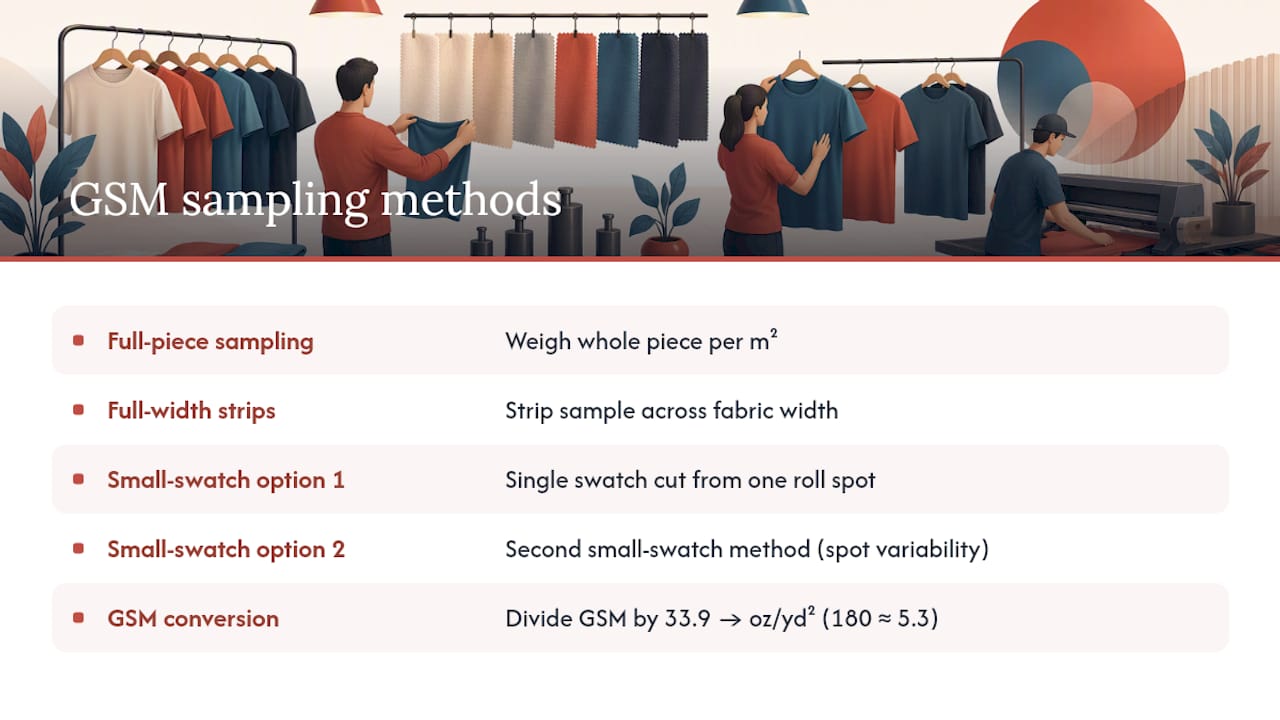
A mill testing full-width conditioned samples is giving you a more reliable figure than one quoting a spot-check from a single swatch.
If you deal in ounces per square yard instead, the conversion is straightforward: divide GSM by 33.9 to get oz/yd². A 180 GSM tee comes out to roughly 5.3 oz/yd², which is the same shirt, just described in the unit American printers tend to use on spec sheets.
One thing worth saying plainly: GSM is a weight measurement, not a quality score. A heavy shirt can still be made from cheap, loosely spun yarn, and a lighter shirt can be made from premium combed cotton that outlasts it. GSM tells you how much fabric you are holding. It does not tell you how well that fabric was made.
What Is a Good GSM for a T-Shirt? A Quick Reference Chart
Different GSM bands feel completely different in hand, and each one tends to suit a distinct use case. The chart below breaks down what to expect at each weight class, along with the rough oz/yd² conversion.
A 240 GSM t-shirt is genuinely thick by standard tee measures. It sits solidly in the “substantial to structured” zone—the kind of weight brands reach for when they want a shirt to hold its shape on a hanger rather than drape like a soft undershirt. Anything past that is a deliberate stylistic choice, not an accident.
The bands above overlap on purpose. A 180 GSM shirt and a 200 GSM shirt can feel closer to each other than two shirts at opposite ends of the same “midweight” label, because knit tightness and fiber blend shift the hand feel independently of the raw number. When you are torn between two adjacent bands, lean heavier if the shirt needs to hold a print or an embroidered logo without sagging, and lean lighter if the priority is airflow or a soft, worn-in drape straight out of the bag.
Ultra-heavyweight territory, 300 GSM and beyond, is where a fabric stops behaving like a typical cotton tee. At 300 to 340 GSM, a knit shirt starts acting like a light sweatshirt, with reduced stretch and a stiffer break-in period. Push to 400 GSM or higher and you are near jacket density, a niche choice for fashion pieces rather than daily-wear basics.
How Does GSM Affect Screen Printing, DTG, and Embroidery?
The decoration method you plan to use should shape the GSM you buy, not the other way around. Each printing technique interacts with fabric weight differently, and picking the wrong pairing shows up as puckering, bleeding, or a print that feels heavier than the shirt underneath it.
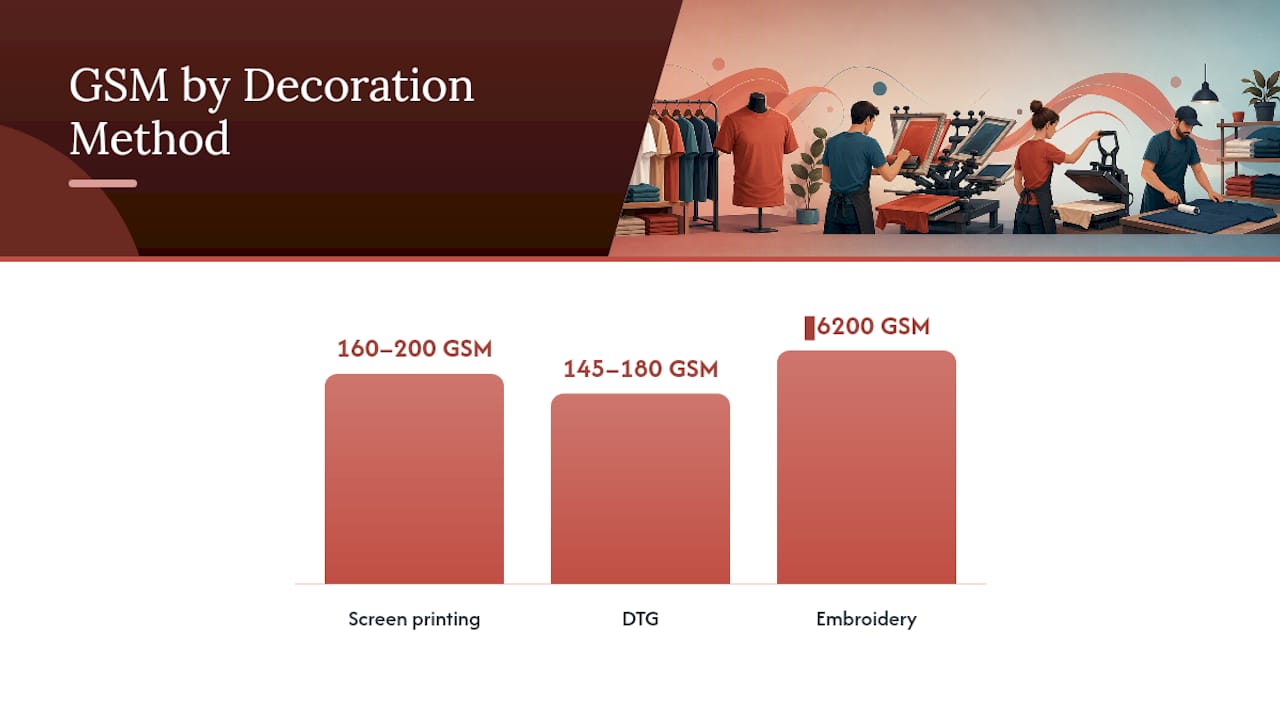
- Screen printing performs best on shirts in the 160 to 200 GSM range. The fabric holds enough body to resist puckering under thick ink deposits, but stays light enough that large graphics do not feel like a rubber sheet glued to the chest.
- DTG (direct-to-garment) printing works most reliably on high-cotton blanks around 145 to 180 GSM. The ink needs to bond with cotton fiber rather than sit on a poly-heavy surface, and lighter, tighter knits soak up detail better than loose heavyweight ones.
- Embroidery wants stability, so 200 GSM and above is the safer starting point. Thin fabric under a dense stitch count tends to pucker or pull, while a sturdier blank holds the stitches flat.
Common failure points to watch for during a test run: puckering around dense ink or stitch areas, ink bleed on loosely knit fabric, and a print that feels stiffer or heavier than the garment itself once it cures. All three are avoidable with the right pairing, but only testing catches them before a full production run does.
Run a proof on the actual blank, in the actual color, at the actual print size before committing to bulk by checking out these best custom t-shirt sites for events that offer fast proofing and rush options. Pretreat DTG blanks exactly as you would in production, and check how backing stabilizer behaves on the specific knit you are using for embroidery. A test on a different weight or color than your final order tells you very little.
Pro Tip: Large coverage prints, like full-front graphics or oversized back designs, hide flaws less than small logos do. Run your biggest, densest artwork as the test print, not your smallest one; if the heaviest coverage design holds up clean, everything smaller will too.
For a deeper breakdown of when to choose one decoration method over the other, screen print vs. embroidery comparisons are worth reading before you lock in a blank.
Which GSM Fits Your Style, Climate, and Silhouette?
Silhouette changes what “good” GSM even means. A fitted, close-to-body tee in 260 GSM fabric feels stiff and unforgiving because there is no room for the fabric to move with you. The same 260 GSM fabric cut into a boxy, oversized shape reads as intentional and structured, because the drape has space to fall rather than cling.
- Hot-weather and layering tees: stay in the 150 to 180 GSM range for breathability and a softer hand feel under another layer.
- Everyday, year-round basics: 180 to 220 GSM balances durability with comfort, the safest all-around zone for a wardrobe staple.
- Premium streetwear and boxy fits: 220 to 260 GSM gives the structure needed for oversized silhouettes to hold their shape instead of sagging by midday.
- Cold-weather or statement heavyweight drops: 260 to 300 GSM, approaching sweatshirt territory, works when the design calls for visible weight and presence.
The trade-offs run in predictable directions. Heavier fabric usually means better opacity, so dark prints stay hidden and colors do not show through, but it also costs more per unit and breathes less. Lighter fabric drapes better and feels cooler against skin, but sacrifices some opacity and structure. There is no universally correct choice here, only the right weight for the silhouette and season you are designing around. If you are building a capsule that mixes weights, a layering guide can help map which combinations actually work together on the body.
Does GSM Alone Tell You Enough About Quality?
No, and this is where a lot of buyers get burned. Two shirts can share the exact same GSM and feel like entirely different garments once you touch them, because GSM is one specification among several that determine how a fabric performs. Fiber content, yarn count, knit type, finish, and seam construction all shape hand feel and durability just as much as raw weight does.
Before comparing two suppliers on GSM alone, check these details:
- Fiber content and blend ratio. A 100% cotton 180 GSM shirt behaves nothing like a 180 GSM poly-cotton blend.
- Yarn count and knit type. Tighter, finer knits often feel denser than their GSM number suggests, while loose open knits can feel lighter than the same GSM implies.
- Finish and treatment. Enzyme washing, brushing, or compacting all change hand feel without touching the underlying weight.
- Collar and seam construction. Ribbed collars, taped shoulders, and reinforced seams add perceived quality that GSM never measures.
- Shrinkage data. Ask for a documented shrinkage percentage after one wash cycle, since a heavy fabric that shrinks 8% can end up feeling smaller and denser than advertised.
Small-swatch testing can mislead you here too. A single patch cut from one section of a roll might read heavier or lighter than the fabric’s true average, which is exactly why ASTM’s own methods include full-piece and full-width options for more representative results. When you are building a tech pack or approving a bulk order, request the test method used, the tolerance range, and a physical sample in your actual chosen color and post-wash state.
Pro Tip: Never approve a sample based on an unwashed swatch in a color you are not actually ordering. Dye processes and wash treatments can shift both hand feel and shrinkage enough to change your entire size grading.
A Quick Checklist Before You Buy Blanks or Finished Tees
Before placing an order, whether you are buying ten shirts or ten thousand, run through this short list:
- Ask which test method and tolerance the supplier used to report GSM.
- Confirm fiber percentage and yarn type, not just the weight number.
- Request a sample in your exact intended color, since dye lots can shift hand feel.
- Run a decoration test (print or embroidery) on the actual blank before bulk production.
- Get documented shrinkage data after one wash cycle.
As a rough starting point by goal: summer tees sit around 150 to 170 GSM, everyday basics land at 180 to 220 GSM, premium streetwear pieces run 220 to 260 GSM, and oversized statement drops push toward 260 to 300 GSM. For a more detailed breakdown of how these numbers translate across different garment categories, the GSM cheat-sheet covers the comparisons in more depth.
Why GSM Shapes Every Design Decision We Make
Every t-shirt we put into production starts with a GSM decision, because that number quietly dictates fit, print outcome, and how the shirt ages after a dozen washes. Our Essential Cotton T-Shirt sits in that reliable everyday midweight zone, built for people who want a tee that holds up to daily wear without feeling heavy. The Unisex Raglan Sleeve Mesh Boxy T-Shirt leans into a boxier, heavier construction, the kind of weight that plays well with an oversized silhouette. When we scale up to hoodies, we push toward 300 to 340 GSM fabric because that category needs the density a t-shirt never will.
If there is one thing worth taking from this: GSM is a starting filter, not a finish line. Read the number, then check the shirt.
— Joshua
Find Your Fit: Everyday and Boxy Tees Built Around the Right Weight
Reading a GSM chart only gets you halfway there. What actually matters is holding the right weight in your hands, which is where Thepreciouslamb’s own lineup comes in as a real-world reference point rather than a theoretical one.

Our Essential Cotton T-Shirt is built in that dependable everyday midweight range, the kind of tee suited for daily wear, casual layering, and anyone who wants substance without added bulk. If you are drawn to a boxier, more structured silhouette, the Unisex Raglan Sleeve Mesh Boxy T-Shirt delivers the heavier hand feel and drape that oversized fits actually need to hold their shape, rather than sagging by the afternoon. Both are made with careful attention to fiber and construction detail, consistent with the brand’s approach across various product lines.
If you want to compare weights and fits side by side before deciding, browse the full t-shirt and apparel collection to see how each piece is built and pick the one that matches your climate, your silhouette, and your plans for printing or everyday wear.
Standards and Guides Behind This Article
The GSM ranges and testing advice above draw on ASTM D3776, the standard test method for fabric mass per unit area, and ISO 3801, its international counterpart. Practical GSM ranges and printing guidance come from industry fabric weight guides covering everyday tees through ultra-heavyweight streetwear pieces.
Sources
- D3776/D3776M Standard Test Methods for Mass Per Unit Area (Weight) of Fabric
- T-Shirt Fabric Weight Guide: What Does GSM Mean? Light vs Heavy Explained (2026) | T-Shirt Elephant
- What does GSM mean in clothing and why it matters more than you think | Rene Bassett
FAQ
What Is a Good GSM for a T-Shirt?
For most everyday wear, 150 to 200 GSM hits the sweet spot between breathability and durability. Go lighter for hot climates or layering, and heavier if you want a shirt with more structure and a longer lifespan under repeated washing.
Is a 240 GSM T-Shirt Thick?
Yes, 240 GSM is genuinely thick for a knit t-shirt and sits in the substantial-to-structured zone most brands use for premium streetwear. It holds its shape better than a standard tee and works especially well for boxy or oversized cuts.
Is 300 GSM Heavy for a Shirt?
Yes, 300 GSM is heavy for a t-shirt and starts to behave more like a light sweatshirt than a typical knit tee. Shirts at this weight have reduced stretch and a stiffer initial feel, so they suit statement or cold-weather pieces rather than everyday basics.
Is a 400 GSM Shirt Good?
A very high fabric weight at jacket density is unusual for standard t-shirts and is usually reserved for niche fashion pieces. It can work for niche, ultra-heavyweight fashion pieces, but most buyers looking for a comfortable, wearable tee will find better results in the 150 to 260 GSM range depending on desired fit and structure.