
Choose ring-spun for premium, printed, or skin-facing garments where softness, print sharpness, and wash-life matter most. Choose open-end (rotor) yarn when the priority is volume and low unit cost, especially in coarser counts where surface finesse won’t be noticed. The trade-off comes down to roughly a 20 to 30 percent tensile-strength advantage for ring-spun against a massive productivity edge for open-end.
TL;DR:
- Ring-spun yarn provides approximately 20 to 30 percent higher tensile strength than open-end yarn, mainly due to longer fiber length and tighter twist.
- Hand-feel and print quality are notably better with ring-spun yarn, which results in smoother fabric and sharper, more durable prints.
- Open-end yarn is significantly faster and cheaper to produce, making it more suitable for bulk utility fabrics, coarse counts, and lower-cost garments.
- For retail essentials requiring longevity, softness, and print clarity, selecting ring-spun and combed ring-spun fabric offers clear advantages despite the higher cost.
- Buyers should verify specific yarn details—spinning method, fiber length, twist, and test samples—before placing large orders to ensure quality and fit for intended use.
Table of Contents
- How Is Ring-Spun Yarn Made?
- How Is Open-End (Rotor) Yarn Made?
- Ring-Spun vs Open-End: Strength, Feel, and Cost Compared
- What Should You Ask Your Mill For?
- Why Yarn Choice Changes How Your Print Actually Looks
- Why We Lean Ring-Spun for Retail Essentials
- See the Fabric Difference in Our Everyday Essentials
- Sources
- FAQ
How Is Ring-Spun Yarn Made?
Ring-spun yarn starts as roving, a loose rope of cotton fibers that’s already been drawn and aligned once. That roving feeds into a ring frame, where a traveler ring and spindle twist and pull the fibers simultaneously, thinning the strand while wrapping it tight. The result is a yarn where fibers run largely parallel to each other instead of bunched at random angles.
That alignment is the whole story mechanically. Parallel fibers pack more densely per cross-section, and the added twist locks loose fiber ends against the yarn’s core instead of letting them stick out. Fewer stray ends means less hairiness on the finished fabric surface, and a denser, more even structure means more force is needed to pull the yarn apart.
Fiber length matters just as much as the spinning method. Ring-spinning typically draws on cotton staple around 1.5 inches or longer, and that length is a big part of why the Cotton Incorporated technical report identifies ring-spun as the finest, softest, and strongest yarn among common spinning systems. Mills sometimes comb the fiber before spinning, stripping out the shortest strands entirely. That combined “combed ringspun” spec shows up constantly on retail-grade apparel because it pushes softness even further.
What that process actually delivers on a finished garment:
- A noticeably softer hand against the skin, since fewer fiber ends poke through the surface
- Higher tensile strength at a given yarn count, which shows up as fewer pulled threads and less seam failure over time
- A smoother, more even surface that takes ink and dye more predictably
- Better drape in lighter-weight knits, since the yarn itself is more uniform in diameter
How Is Open-End (Rotor) Yarn Made?
Open-end spinning skips the roving stage entirely. Fiber gets fed directly into a spinning rotor, a small high-speed drum that uses centrifugal force to collect fibers into a groove and twist them into yarn as they’re drawn out the center. There’s no traveler, no ring, and no separate roving-forming step, which is exactly why the process is faster and cheaper to run.
The mechanics create a structurally different yarn. Fibers wrap around the yarn’s core in layers rather than lying fully parallel, and a portion of them form what’s called a wrapper-fiber effect, loose strands twisted loosely around the main body. That’s the source of open-end’s characteristic hairiness and its bulkier, less uniform surface.
Where open-end genuinely wins is throughput. According to the same Cotton Incorporated report, a single rotor position can produce yarn at 8 to 10 times the rate of a single ring-spinning position under typical conditions. That gap is why open-end dominates categories where cost per pound matters more than finish.
Common outcomes from rotor production:
- Coarser yarn counts, since the process struggles to hold fine, consistent diameters at high speed
- Shorter fiber requirements, often under 1 inch, which lets mills use lower-grade cotton stock
- Heavier, more textured fabrics suited to workwear, denim, and utility goods
- Significantly lower cost per pound of finished yarn
Ring-Spun vs Open-End: Strength, Feel, and Cost Compared
The clearest, most citable difference between the two is tensile strength. Textile industry analysis puts ring-spun yarn at roughly 20 to 30 percent stronger than open-end yarn of the same count, a gap driven almost entirely by fiber length and twist density rather than raw cotton grade.
The 20 to 30 percent strength gap isn’t marketing language. It’s a measurable outcome of longer fibers and tighter twist, and it’s the single number worth remembering if you only remember one.
Hand-feel and surface follow the same logic. Ring-spun’s parallel fiber structure reads smoother under the hand and shows fewer stray fibers under magnification, while open-end’s wrapper fibers create a rougher, hairier texture that’s noticeable even before decoration goes on.
Printability splits along the same lines. Ring-spun’s tight, even surface accepts fine-line prints with clean dot definition, while open-end’s hairier surface tends to bleed ink at the edges, softening detail that would otherwise stay sharp. Durability tracks with strength: ring-spun fabric generally resists pilling better and holds its surface through more wash cycles before fuzzing sets in.
Here’s what the trade-off looks like in practice:
- Strength: ring-spun holds a clear edge; open-end is adequate for lower-stress garments
- Feel: ring-spun smoother and cooler to the touch; open-end coarser, more textured
- Print fidelity: ring-spun sharper detail; open-end softer, sometimes bled edges
- Cost and speed: open-end wins decisively on both, thanks to that 8 to 10x productivity gap
- Pilling resistance: ring-spun ages better under repeated washing and abrasion
Pro Tip: Run the numbers before defaulting to the cheaper yarn. Procurement guidance puts the typical ring-spun premium at $0.50 to $1.50 per garment. If that premium cuts your reprint rate or return rate even modestly, it pays for itself faster than most people expect.
What Should You Ask Your Mill For?
Getting the yarn you actually specified starts with asking for the right paperwork, not just trusting a swatch. Before signing off on a bulk order, request these items in order:
- Spinning method confirmation in writing: ring-spun or open-end, stated explicitly on the mill’s yarn certificate.
- Staple length and combing status, since a mill quoting “cotton” without fiber length data is telling you nothing useful.
- Twist per inch and yarn count, both of which affect hand-feel and strength independently of spinning method.
- A physical master sample with your actual artwork or dye lot applied, not a generic fabric swatch.
- Tensile and print-quality testing, using AATCC or ASTM methods where garment longevity is a real concern.
The master sample step is the one most buyers skip, and it’s the one that causes the most expensive mistakes. A print that looks fine on a lab swatch can fail visibly once it’s run at production scale on open-end fabric, since the surface hairiness that looked minor under normal light shows up clearly once ink is applied at volume.
Pro Tip: Inspect the master sample under magnification, not just by eye. Ring-spun edges stay crisp under a loupe; open-end edges show visible fuzz even when they look acceptable from arm’s length.
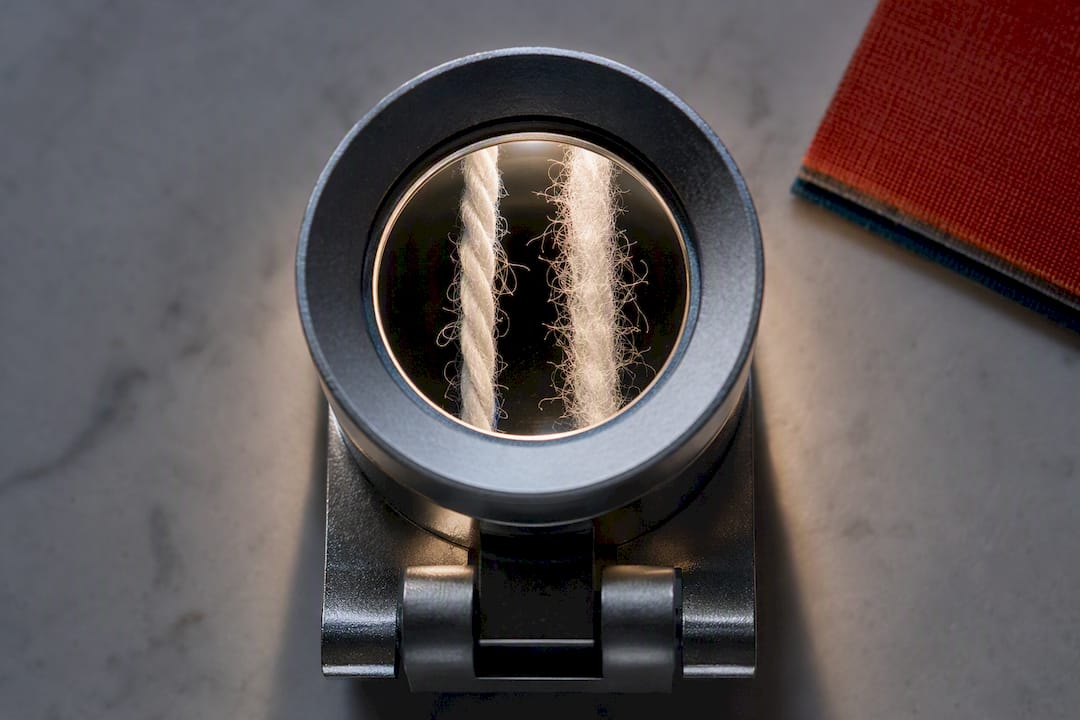
Open-end remains the right call for coarse counts, heavyweight utility garments, and runs large enough that a few cents per unit compounds into real savings. It’s the wrong call anywhere fine print detail or long-term softness is part of your product promise.
Why Yarn Choice Changes How Your Print Actually Looks
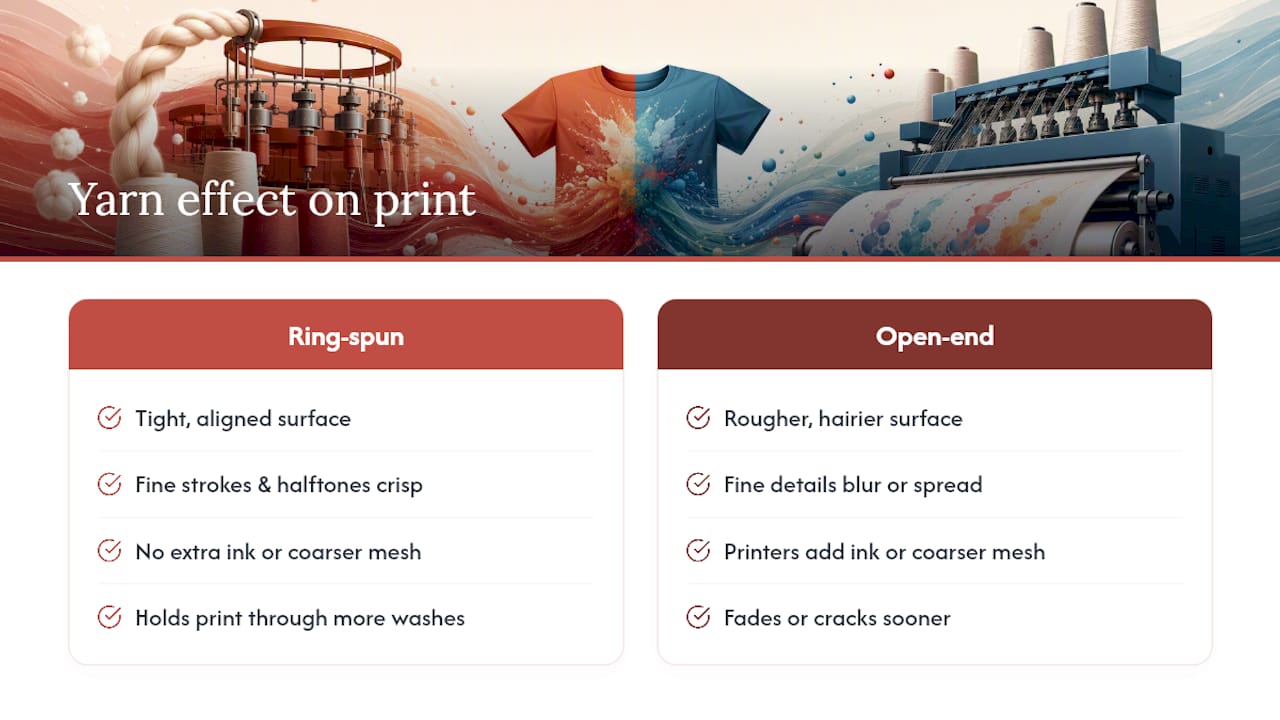
The spinning method decides how forgiving your artwork can be. Ring-spun’s tight, aligned surface lets a printer run fine strokes and tight halftone dots without the ink spreading past its intended edge, which matters enormously for detailed logos or small type.
Open-end’s rougher surface forces compromises. Printers sometimes push more ink deposit or shift to a coarser mesh count to compensate for the hairier fabric, but neither move fully replicates the crispness ring-spun delivers naturally. You can improve open-end’s printed result somewhat; you can’t fully match it.
The gap widens over the life of the garment. Ring-spun fabric tends to hold its printed surface and color through more wash cycles before visible fading or cracking sets in, largely because the same tight structure that resists pilling also protects the ink bond. Whatever the spinning method, proof against a fully finished master sample. Do not trust an unwashed, undecorated swatch to predict what customers will actually see.
Why We Lean Ring-Spun for Retail Essentials
Retail essentials live or die on repeat wear, not first impression. That’s why Thepreciouslamb leans toward ring-spun and combed ring-spun fabric for core pieces meant to be worn often and washed constantly. Softness that holds up past the tenth wash matters more to a customer than a marginally lower price tag ever will.
Print fidelity plays into that same decision. A design that stays crisp instead of blurring at the edges after a few washes is the difference between a shirt someone keeps and one they quietly retire. Fabric specs aren’t an afterthought here. They’re part of the product itself.
— Joshua
See the Fabric Difference in Our Everyday Essentials
Everyday staples are often built on ring-spun and combed cotton where softness and print clarity matter to garment longevity. This represents a common advantage over generic basics built on lowest-cost yarn. The difference in hand-feel is often noticeable before the fit.

The Essential Cotton T-Shirt is a straightforward example: a retail tee built on the fiber logic covered above rather than a coarse, bulk-spun fabric that fades fast. If you want something more structured for heavier-use pieces, the Unisex Boxy Heavyweight Short Sleeve Shirt shows where a sturdier construction fits. Browse the full T-Shirts, Shirts, and Denim Jeans collection to compare fabric descriptions across pieces and see which construction fits what you’re shopping for, then check sizing and place your order directly from the product page.
Sources
- Open end vs ring spinning cotton yarn quality
- Cotton Spun Yarns for Knit and Woven Fabrics (Cotton Incorporated technical report)
- Ring Spun Cotton vs Open End Cotton: A Procurement Guide to Yarn Quality
- Ring-spun vs Open-end cotton (practical printing and fabric notes)
FAQ
What Is the Difference Between Open-End and Ring-Spun Yarn?
Ring-spun yarn is made from roving twisted on a ring frame, producing parallel fiber alignment, higher strength, and a smoother surface. Open-end (rotor) yarn skips the roving stage and spins fiber directly in a rotor, producing a hairier, coarser yarn at much higher production speed.
Is 100% Ringspun Cotton the Same as 100% Cotton?
Not exactly.
Is Ring-Spun Cotton Good Quality?
Yes. Ring-spun cotton is generally considered the higher-quality option because its fiber alignment produces roughly 20 to 30 percent greater tensile strength, a softer hand, and sharper print results than open-end cotton.
Will 100% Ring-Spun Cotton Shrink?
Ring-spun cotton can shrink somewhat with washing, similar to other 100% cotton fabrics, since the shrinkage comes from the cotton fiber itself relaxing, not from the spinning method. Pre-shrunk or combed ring-spun options minimize this, and Thepreciouslamb lists fabric composition on each product page so you know what to expect before washing.