
Supply chain transparency in fashion means a brand publishes verifiable information about where and how its garments are made, from raw fiber to finished product, so consumers, workers, and regulators can check the claims for themselves. The immediate payoffs are concrete: fewer hidden labor violations, better tracking of environmental damage, and a real basis for consumer trust instead of a marketing slogan. The rest of this guide explains how that transparency gets measured and how you can verify it before you believe it.
TL;DR:
- Only a small fraction of brands publish full supply chain disclosures, and most disclosures lack specific details like factory or certificate numbers.
- Verifiable transparency requires brands to disclose identifiable factory names, certification numbers, and clear, accessible audit summaries.
- Digital tools such as factory registry IDs, product passports, and chain-of-custody certifications can improve traceability but are often still in pilot stages and not industry-wide.
- Transparency scores from indices and registries should be cross-checked, as voluntary reporting often emphasizes positive data over full disclosure.
- Consumer verification relies on searching for specific factory or certificate details and evaluating how proactively and clearly a brand presents these disclosures.
Table of Contents
- What Do Supply Chain Transparency and Traceability Mean in Fashion?
- Why Supply Chain Transparency Matters for the Fashion Industry
- What’s Blocking Full Supply Chain Transparency in Fashion?
- How Do Brands Actually Improve Supply Chain Transparency?
- How Is Fashion Supply Chain Transparency Measured?
- What Makes a Brand’s Transparency Believable to Shoppers?
- How Thepreciouslamb Approaches Verification and Disclosure
- The Bottom Line on Verifying Transparency Claims
- How Are Government Policies Shaping Fashion Transparency?
- How Does Transparency Reduce Supply Chain Risk?
- Can Brands Protect Trade Secrets While Staying Transparent?
- What ThePreciousLamb’s Approach Tells Us About Doing This Right
- See Real Product Pages and Learn to Verify Any Brand’s Claims
- Where to Verify Transparency Claims Yourself
- Sources
- FAQ
What Do Supply Chain Transparency and Traceability Mean in Fashion?
Transparency, traceability, and visibility get used interchangeably, and that is part of the problem. Transparency is the act of disclosing information publicly. Traceability is the technical ability to track a garment’s path through production. Visibility is what a brand itself can see internally, which is not the same as what it chooses to share. A company can have excellent internal visibility and still disclose almost nothing to the public.
A garment’s journey typically runs through several tiers before it reaches a store shelf. Tier 1 covers the factories that cut and sew the final product. Tier 2 covers fabric mills and dye houses. Tier 3 covers yarn spinners. Tier 4 reaches back to raw material producers, cotton farms, sheep ranches, or petrochemical plants making synthetic fibers. Most brands can name their Tier 1 partners. Very few can name their Tier 4 partners, because the paper trail thins out fast the further back you go.
Disclosure at the product level takes a few recognizable forms:
- Factory lists naming the specific facilities that made a garment, sometimes cross-referenced with facility IDs
- Material origin statements specifying where cotton, wool, or synthetic fibers were sourced
- Digital product passports attached to individual items with scannable codes linking to production data
- Audit summaries describing labor conditions and remediation actions at named facilities
The gap between having this information and publishing it is where most of the industry currently sits. A brand can know exactly which factory dyed a shirt and still say nothing about it on the product page.
Why Supply Chain Transparency Matters for the Fashion Industry
Transparency changes outcomes for four groups: the environment, workers, brands, and shoppers.
Environmentally, disclosed material origins and processing methods let independent researchers and NGOs verify claims about water use, chemical runoff, and carbon output instead of taking a brand’s word for it. That verification pressure pushes brands toward genuine circularity efforts rather than symbolic ones, because a published claim can be checked against a named supplier.
On the labor side, publishing audited supplier information gives independent monitors a way to catch violations before they become a scandal. The Fair Labor Association argues that publishing factory lists and audit data specifically enables outside monitoring and faster remediation when problems surface, rather than leaving oversight entirely in the brand’s own hands.
For brands, the business case is straightforward:
- Disclosed supply chains reduce the risk of being blind sided by a factory collapse or labor scandal tied to an unnamed subcontractor
- Regulatory pressure in several markets is moving toward mandatory reporting, so brands that build disclosure habits now avoid a scramble later
- Transparent brands tend to earn more durable trust than brands that rely on vague sustainability language
Only a small share of fashion brands currently publish anything close to full supply-chain disclosure, according to independent transparency barometer reviews, which means most of the industry is still working from partial or absent information even when it claims otherwise.
One caveat worth stating plainly: transparency is not the same as sustainability. A brand can disclose its entire supply chain and still run a genuinely damaging operation. Disclosure makes accountability possible. It does not guarantee good behavior on its own.
What’s Blocking Full Supply Chain Transparency in Fashion?
Several structural problems keep even well-intentioned brands from disclosing everything.
- Fragmented supplier networks. A single garment can pass through a dozen facilities across several countries, and Tier 1 factories often subcontract work without telling the brand, creating hidden tiers nobody upstream knows about.
- Inconsistent reporting standards. Without a shared format, one brand’s “audited” facility list means something different from another brand’s, making side-by-side comparison nearly impossible for outside observers.
- Poor data quality. Supplier information gets collected through self-reported surveys that are rarely verified independently, so the data entering public reports can be outdated or simply wrong. 8s
- Commercial confidentiality. Suppliers often work for multiple competing brands and worry that revealing capacity, pricing, or client lists will hurt their negotiating position, which makes them resist disclosure even when the brand wants it.
- Cost and technical barriers. Smaller mills and Tier 3 or Tier 4 suppliers frequently lack the systems or staff to track and report data in the format brands request, especially in regions with limited digital infrastructure.
- Greenwashing and selective disclosure. Some brands publish partial information, a handful of certifications or a single supplier list, and present it as comprehensive transparency, which muddies the picture for anyone trying to compare brands fairly.
None of these barriers are unsolvable, but they explain why full traceability remains the exception rather than the rule across the industry.
How Do Brands Actually Improve Supply Chain Transparency?
Improving transparency usually starts with a simple, unglamorous act: publishing the factory list. Brands that link their Tier 1 and Tier 2 suppliers to entries in the Open Apparel Registry give researchers and journalists a standardized way to confirm which facilities they actually use, since each factory gets a unique ID that stays consistent across brands referencing the same site.
Beyond factory lists, a handful of technologies are doing the heavier lifting:
- Digital product passports attach a scannable code to a garment that links to real production data, not just marketing copy
- Fiber tagging physically marks raw material so its presence can be verified later in the finished textile, a technique companies like FibreTrace have piloted with large retailers
- Chain-of-custody certifications track a material’s paper trail from farm or field to finished product through a formal auditing chain
- RFID and serial tracking attach unique identifiers to individual units so a garment’s location and handling history can be pulled up on demand
- Blockchain pilots record supply chain transactions on a shared ledger that is difficult to alter after the fact
Research on these tools generally agrees they increase traceability, but the honest caveat is that a pilot program covering one product line is not the same as a company-wide standard, and consumers should not assume one proves the other. Studies on RFID, blockchain, and digital passports consistently find these methods raise observability of a product’s journey from sourcing to retail, but adoption still varies enormously by brand size and budget.
What separates a credible public disclosure from a marketing gesture usually comes down to specificity: a genuine disclosure names a certificate number, states the auditor and the date, and describes what remediation happened after a problem was found. A vague “we audit our factories” statement with no names or numbers is not verification. It is a sentence.
Pro Tip: Before trusting a brand’s sustainability claim, search the exact certificate number or factory name it cites. If neither shows up anywhere outside the brand’s own marketing page, treat the claim as unverified.
How Is Fashion Supply Chain Transparency Measured?
Three tools dominate how the industry scores and cross-checks disclosure, and each measures something different.
- The Fashion Transparency Index, published annually by Fashion Revolution, reviews large brands on what they publicly disclose about social and environmental policies and impacts. A high score means a brand discloses a lot of information. It does not automatically mean the brand’s practices are good, only that you have enough information to judge them.
- The Open Apparel Registry functions as a cross-reference tool. If a brand claims to use a specific factory, you can check whether that facility’s ID matches records other brands or researchers have logged against the same site.
- The Higg Index, run by the Sustainable Apparel Coalition, measures environmental impact, like water use, emissions, and chemical management, rather than disclosure itself. A brand can score well on Higg’s environmental modules while scoring poorly on the Transparency Index if it measures its impact internally but shares little of that data publicly.
The practical lesson is that none of these tools work alone. Index scores capture what is voluntarily reported, and voluntary reporting has an obvious blind spot: brands report what makes them look good and often stay quiet about the rest. Cross-checking a factory list against the Open Apparel Registry, comparing a brand’s Higg data against its Transparency Index score, and reading the actual audit summaries when they exist gives a far more reliable picture than trusting any single number.
What Makes a Brand’s Transparency Believable to Shoppers?
Academic research on how people actually judge transparency identifies three distinct cues, and they matter more than sheer data volume. Observability means there is actual evidence to look at, not just a promise. Comprehensibility means that evidence is presented in a way a normal shopper can understand without a research background. Intentionality means the brand disclosed the information proactively, rather than being forced into it after a scandal broke.
That third cue explains something counterintuitive: dumping a 200-page supplier spreadsheet on a website can actually read as less trustworthy than a short, clear summary, because consumers respond to clarity and proactive framing more than to raw volume of disclosed data. A wall of unreadable data can look like an attempt to hide behind complexity.
A short checklist for judging any brand’s claim:
- Can you find a specific, searchable factory name or registry ID?
- Does the brand cite certificate numbers rather than just certification logos?
- Is there product-level traceability, like a QR code linking to real data?
- Are audit summaries written in plain language, or buried in jargon?
One data point worth remembering: transparency perception in this research is subjective and cue-based, not a straight function of how much information exists. A brand that says less, clearly, can out-trust a brand that says more, confusingly.
How Thepreciouslamb Approaches Verification and Disclosure
The brand treats transparency as a habit rather than a campaign, publishing behind-the-scenes content on materials and construction alongside product pages so shoppers can see more than a finished photo. A related resource, how to verify ethical clothing before you buy, walks through the specific checks a shopper should run on any brand’s claims, and it pairs well with the material comparison in recycled polyester vs cotton for anyone weighing fabric choices against sustainability claims.
For shoppers, a workable verification checklist looks like this:
- Search the brand’s named factories or suppliers independently, don’t just take the “about” page at face value
- Look for certificate numbers, not just certification logos
- Check whether product pages mention material origin specifically, not generically
For smaller brands building their own practices, the equivalent checklist starts with mapping suppliers honestly, even the uncomfortable gaps, detailed further in direct-to-consumer clothing: a guide for brand builders.
The Bottom Line on Verifying Transparency Claims
Progress on fashion supply chain transparency is real but incremental, and no brand, including large, well-resourced ones, discloses everything. What you can do right now is measurable. As a consumer, ask for factory IDs and certificate numbers before trusting a sustainability claim, and favor brands that present disclosures clearly over brands that bury you in data. Hold brands against the Fashion Transparency Index and Open Apparel Registry rather than their own marketing copy.
If you run a brand, the priority order matters: map your suppliers honestly first, publish a readable summary of what you find second, and invest in verifiable material tracing third. Skipping straight to fancy traceability tech without first knowing your own supplier map just produces impressive-looking data about an incomplete picture.
How Are Government Policies Shaping Fashion Transparency?
Regulation is starting to do what voluntary disclosure never fully achieved: forcing a baseline. Several markets are moving toward mandatory supply chain reporting requirements that compel companies above a certain size to disclose supplier information and human rights due diligence, regardless of whether they want to.
This shift changes the incentive structure for brands. Voluntary transparency initiatives compete for attention and budget against every other business priority, which is part of why disclosure has stayed inconsistent across the industry for so long. Mandatory reporting removes that competition. A brand that has to report by law reports on a schedule, in a format regulators can compare across companies, rather than whenever it suits a marketing calendar.
Industry-level standards play a supporting role here too. When enough brands adopt the same registry IDs and the same reporting modules, comparison gets easier for everyone, including regulators trying to enforce new rules without reinventing a data format from scratch. The Open Apparel Registry’s shared ID system is a small but genuine example of this kind of standardization working in practice.
The honest limitation is that regulation moves slower than supply chains do, and enforcement varies enormously by jurisdiction. A reporting requirement with no real penalty for noncompliance functions more like a suggestion. Readers evaluating a brand’s regulatory claims should check whether the disclosure was legally required or genuinely voluntary. The difference tells you a lot about how much credit the brand deserves for it.
How Does Transparency Reduce Supply Chain Risk?
A supply chain you cannot see is a supply chain you cannot manage, and that gap shows up as risk in three predictable places: reputational, operational, and financial.
Reputational risk is the most visible. A factory collapse, a child labor finding, or a toxic dye spill tied to an unnamed subcontractor can blind side a brand that never mapped its own Tier 2 or Tier 3 suppliers. When a brand has already published its factory list, at least it knows what it is dealing with before a journalist tells it.
Operational risk works similarly. A brand that only knows its Tier 1 partners has no early warning if a Tier 3 dye house shuts down, gets sanctioned, or loses a certification. Mapping deeper into the supply chain, even imperfectly, gives a business time to find a replacement supplier before a shortage becomes a missed shipping deadline.
Financial risk follows from both. Investors and lenders increasingly factor supply chain disclosure into how they price risk, treating an opaque supplier network as a liability similar to any other undisclosed contingency. A brand that cannot answer basic questions about its own sourcing looks riskier to anyone writing a check, regardless of how good its actual practices are.
None of this means transparency eliminates risk. It means transparency converts unknown risk into known, manageable risk, which is a meaningfully different position to be in when something does go wrong.
Can Brands Protect Trade Secrets While Staying Transparent?
Suppliers have legitimate reasons to resist full disclosure, and pretending otherwise doesn’t help anyone move forward. A fabric mill working for five competing brands has real commercial reasons to keep its client list and pricing structure private. A factory revealing its full capacity to the public hands that information to competitors negotiating for the same production slots.
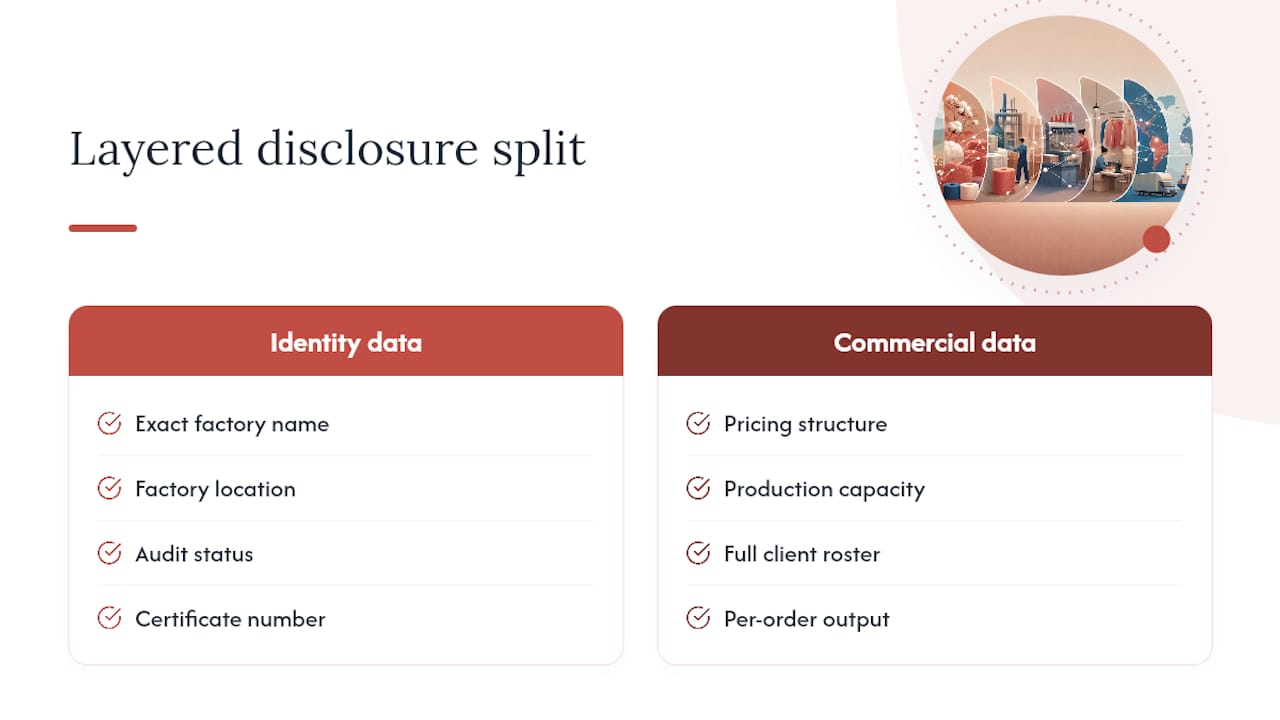
The practical solution most transparency advocates land on is layered disclosure rather than all-or-nothing disclosure. A brand can publish a factory’s name, location, and audit status, the information that lets outside monitors check labor conditions, without publishing that factory’s pricing, capacity, or full client roster, the information that actually damages a supplier’s negotiating position. The Open Apparel Registry’s ID system works partly because it standardizes exactly this kind of layered approach: enough to verify, not enough to compromise a supplier’s business.
Digital product passports raise a related but distinct concern: how much production data should travel with an individual item versus stay aggregated at the brand level. A passport that reveals a specific factory’s exact output volume for a single order risks exposing commercially sensitive detail that has nothing to do with a shopper’s right to know where their shirt was made.
The solutions that seem to hold up involve aggregating sensitive data (total volume across many orders, not per-shipment detail) while keeping identity data specific (exact factory name, exact certificate number). That split lets independent monitors verify who made a garment and how, without forcing suppliers to expose the commercial details that keep them competitive.
What ThePreciousLamb’s Approach Tells Us About Doing This Right
Here’s what the research keeps circling back to, and what most transparency coverage misses: volume of disclosure and quality of disclosure are not the same thing, and treating them as interchangeable is where a lot of well-meaning transparency advice goes wrong. A brand that publishes a factory list and stops there has technically disclosed something. A brand that names the factory, cites the certificate number, and explains in plain language what an audit found has actually made itself accountable.
Conventional coverage of this topic tends to treat any disclosure as progress. I’d push back on that. Partial disclosure without specificity, a certification logo with no number, a “we audit our factories” line with no auditor named, is closer to a marketing choice than a transparency practice. It looks like accountability without carrying any of the actual risk of being checked.
What should a reader prioritize first? Not the biggest index score or the flashiest blockchain pilot. Start with the smallest, checkable claim a brand makes, one factory name, one certificate number, and see if it holds up independently. A brand that gets the small, checkable claims right is a far better bet than one boasting about a comprehensive program you have no way to verify.
— Joshua
See Real Product Pages and Learn to Verify Any Brand’s Claims
This brand gives you something most sustainability content doesn’t: an actual storefront to practice verification skills on, instead of just theory about what transparency should look like. Product pages describe materials and construction in plain terms, so shoppers can apply the same checklist covered above, looking for specific origin details, readable descriptions, and not just vague certification badges standing in for real information, to real shopping decisions.

Browse the full clothing collection or check out current bestsellers and new arrivals to see how product-level detail should actually read. If you want the verification steps laid out in full before you shop anywhere, the ethical clothing verification guide walks through exactly what to check on any brand’s product page, Thepreciouslamb’s included. Start there, then shop with a sharper eye.
Where to Verify Transparency Claims Yourself
A handful of sources let you check any brand’s disclosure claims independently rather than taking marketing copy at face value.
- Fashion Transparency Index for annual brand disclosure scores
- Open Apparel Registry for cross-checking factory IDs against public records
- Higg Index through the Sustainable Apparel Coalition for environmental impact modules
- Fair Labor Association for labor auditing standards and remediation practices
Sources
- Fashion Transparency Index
- Consumerbased conceptualisation of brand transparency: scope, characteristics and contextual determinants
- Supply Chain Transparency - Fair Labor Association
- Impacts of Transparency and Traceability on Fashion Supply Chain System
FAQ
What Is Supply Chain Transparency?
Supply chain transparency is the public disclosure of verifiable information about where and how a product was made, covering factories, materials, and labor conditions. It differs from traceability, which is the internal technical ability to track that same information, whether or not it gets shared publicly.
What Supply Chain Issues Currently Face the Fashion Industry?
The biggest barriers are fragmented supplier networks with hidden subcontracting, inconsistent reporting standards between brands, and commercial confidentiality concerns from suppliers who work with multiple competing clients. Independent transparency barometer reviews show that only a small share of brands currently publish full disclosure across their supply chain.
What Role Does Transparency Play in the Fashion Industry?
Transparency lets consumers, workers, and regulators verify a brand’s environmental and labor claims instead of relying on marketing language alone. It supports risk management, enables independent monitoring by groups like the Fair Labor Association, and shapes consumer trust when disclosures are clear and proactive rather than reactive.
What Is a Supply Chain in the Fashion Industry?
A fashion supply chain is the full chain of production from raw material (Tier 4) through spinning (Tier 3), fabric and dye production (Tier 2), to final garment assembly (Tier 1). Most brands can name their Tier 1 factories confidently, but visibility usually thins out significantly by Tier 3 and Tier 4.
How Can I Check If a Brand’s Transparency Claims Are Real?
Look for specific, checkable details: a factory name you can search independently, a certificate number rather than just a logo, and product-level information about material origin. Guides like Thepreciouslamb’s ethical clothing verification walkthrough outline the exact steps to run this check on any brand’s product page.