
T-shirt layering works when you control three things: proportion, fabric weight, and neckline contrast. Get those right and the look reads editorial. Get them wrong and it reads like you grabbed whatever was on the floor. The runway-inspired approach that took hold in 2025 — boxy short-sleeve over a slim long-sleeve, relaxed trousers, clean shoes — proves the formula doesn’t require expensive pieces. It requires intention.
Three combos you can wear right now:
- Boxy tee over slim long-sleeve: Outer tee 1–2 inches shorter than the inner, contrasting necklines (crew over mock-neck), neutral palette.
- Short tee over short tee, different lengths: Let the inner hem peek 1–2 inches below the outer. Works best in tonal colors so the hem reads deliberate, not accidental.
- Trim tee under an open overshirt: Tuck the tee slightly or leave it out; the overshirt frames it. Cotton tee plus linen or oxford cloth overshirt is the texture contrast that makes this land.
Key Takeaways
Layered T-shirt outfits look intentional when you control proportion, fabric weight, and neckline contrast — every other detail follows from those three rules.
| Point | Details |
|---|---|
| Control proportion first | Keep the inner hem 1–2 inches longer than the outer for a deliberate layered line. |
| Match fabric weights correctly | Use lightweight jersey as a base layer; reserve heavyweight cotton for outer pieces only. |
| Vary neckline heights | Avoid stacking two identical necklines — contrast (crew over mock-neck, V-neck under crew) creates visible separation. |
| Let hems and cuffs show | Visible inner hems and sleeve cuffs signal intention; inconsistent exposure reads as a sizing mistake. |
| Thepreciouslamb for layering | Curated pieces like the Denim Vintage Washed Heavyweight Jacket and Contrast Piped Button-Up Jersey are built for hem clearance and proportion control. |
Table of Contents
- What are the best T-shirt-on-T-shirt combos?
- How do you pair a T-shirt with sweaters, vests, and jackets?
- How do T-shirt size, length, and fabric affect layering?
- How do T-shirts fit into a winter layering system?
- What layering mistakes should you avoid?
- Three outfit recipes using Thepreciouslamb pieces
- How do you stay comfortable when layering T-shirts?
- How should you accessorize a layered T-shirt outfit?
- Why layered tees are the styling move most people underestimate
- Build your layered look with Thepreciouslamb
- Sources
What are the best T-shirt-on-T-shirt combos?
The non-Y2K approach to layering tees comes down to one word: selectivity. You’re not stacking tees for warmth or nostalgia. You’re using the second layer to add visual structure.
Short-sleeve over long-sleeve
This is the combo that The Row made unavoidable in 2025 and that high-street brands picked up by early 2026. The outer tee should be slightly boxier or at minimum the same width as the inner, never narrower. Hem difference matters: the long-sleeve should show 1–2 inches below the short-sleeve hem, and the cuffs should extend past the outer sleeve by a similar margin. Fabric rule: lightweight jersey underneath, midweight cotton on top. Pair with straight-leg or relaxed trousers and low-profile sneakers or loafers. Chunky boots work for streetwear builds.

Short over short with differing lengths
The risk here is looking like you ran out of laundry options. The fix is color discipline. Keep both tees in the same tonal family (two shades of the same color, or black and charcoal) so the hem peek reads as a design choice. The inner tee should be 1–2 inches longer. Avoid graphic tees on both layers — one graphic maximum, and put it on the outer piece.
Long over long (thin layers)
Two long-sleeves work when both are genuinely thin: a lightweight jersey or a fine-knit mock-neck underneath, a slightly looser long-sleeve on top. The moment either piece is midweight, you get bulk at the torso and the look collapses. This combo suits transitional weather and reads best with slim or tapered bottoms to offset the upper-body volume.
Pro Tip: Roll the outer sleeve once or twice when doing short-over-long. It exposes the inner layer’s cuff, adds a deliberate detail, and prevents the outer sleeve from swallowing the inner one.
How do you pair a T-shirt with sweaters, vests, and jackets?
Tees don’t just layer with other tees. They anchor more structured outfits too, and the rules shift depending on what’s going on top.
Under a crewneck sweater: Use a V-neck or scoop-neck tee so the neckline peeks above the sweater’s collar. A crew-neck tee under a crewneck sweater creates a stacked-collar effect that reads bulky rather than intentional. The tee hem should sit at or slightly below the sweater hem — no more than an inch of tee showing at the bottom.
Under a V-neck sweater: A crew-neck tee works perfectly here. The crew collar fills the V and gives the outfit a layered depth without competing necklines. Keep the tee trim and tucked or just barely untucked.
Under a button-down or overshirt: Show 1–2 inches of tee at the hem and let the collar sit naturally inside or just above the button-down’s collar. The texture contrast is the point: a plain cotton tee under a linen or oxford-cloth overshirt gives the outfit tactile interest without effort. Leave the overshirt open for casual reads, button it to the second button for smart-casual.
Under a sweater vest: Fit is everything. A boxy tee under a sweater vest looks like a school uniform. A trim tee — shoulder seams sitting right at the shoulder edge, sleeves that frame the arm without clinging — makes the vest look intentional. Let the tee’s hem show 1–2 inches below the vest.
Under a jacket or coat:
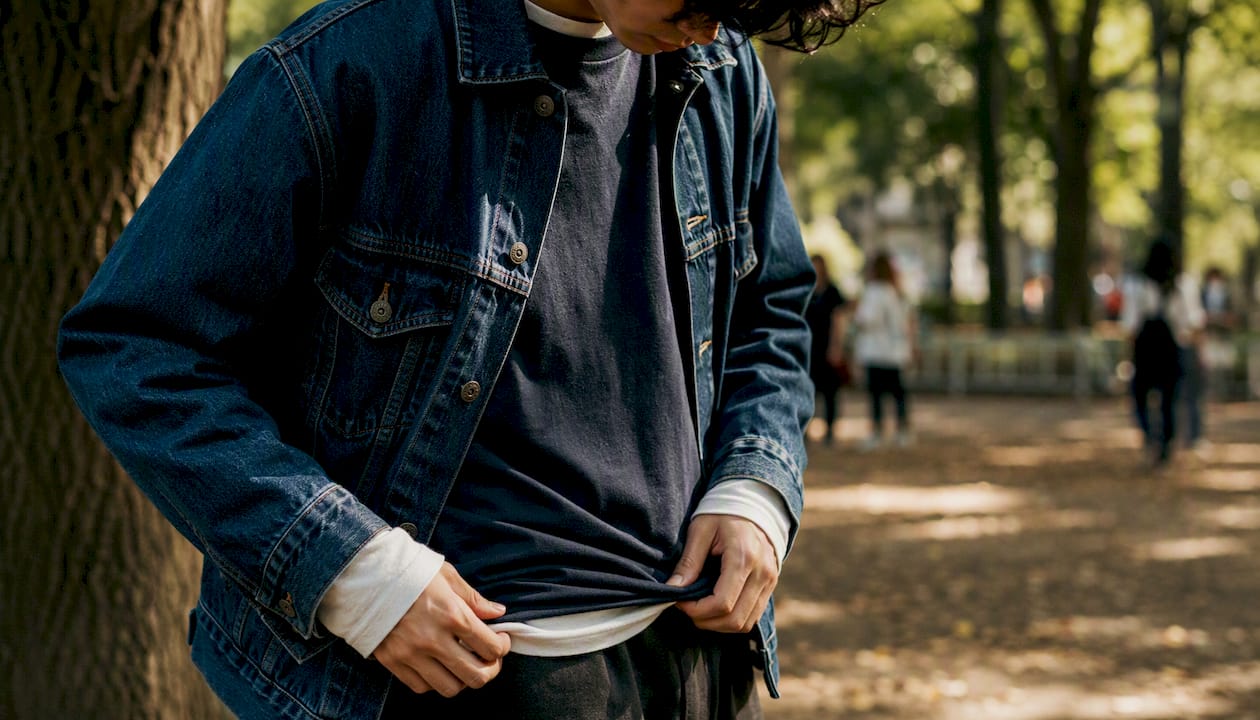
- Let the tee’s hem drop 1–2 inches below a denim jacket’s hem for visible layering.
- Show the inner tee’s cuffs below a leather jacket’s sleeves for dimension.
- With a longer coat, tuck the tee or keep it just at the waistband so the coat’s silhouette stays clean.
- Thepreciouslamb’s Denim Vintage Washed Heavyweight Jacket and Vintage Wash Zip Denim Jacket are built with the hem clearance and sleeve length, making tee-peeking look considered rather than careless.
How do T-shirt size, length, and fabric affect layering?
The fit checks that separate editorial from accidental are shoulder seam placement, sleeve framing, and hem length. Shoulder seams should sit at the shoulder’s edge — not drooping onto the arm, not riding up toward the neck. Sleeves should frame the arm without pulling across the bicep or hanging loose. These details matter twice as much when layering because misalignment on the base layer telegraphs through the outer piece.
Fit rules for layering:
- Base layer: trim fit, no bunching at the torso when tucked or overlapped.
- Outer tee: boxy or relaxed, depending on the silhouette you want. A boxy outer over a slim base is the most forgiving combination for most body types.
- For a leaner silhouette, keep both layers slim and rely on hem difference for visual interest rather than fit contrast.
| Weight | Fabric Examples | Best Layering Use |
|---|---|---|
| Lightweight | Fine jersey, modal, bamboo | Base layer; wears under anything without bulk |
| Midweight | Standard cotton, poly-cotton | Stand-alone or controlled outer layer |
| Heavyweight | Thick cotton, French terry | Outer layer only; too stiff and warm underneath |
For body types that carry more volume in the torso, a longer base layer with a cropped or boxy outer tee creates a vertical line that lengthens the look. Petite frames benefit from keeping hem differences tight — 1 inch rather than 2 — so the proportions don’t overwhelm.
Pro Tip: Avoid stacking two crew-neck tees of the same height. The necklines merge into one thick band that reads as a single, shapeless collar. Drop one neckline (V-neck or scoop) or raise one (mock-neck) to create visible separation.
How do T-shirts fit into a winter layering system?
The three-layer rule applies directly to tees. Base layer pulls moisture away from skin; mid layer traps warmth; outer layer blocks wind and weather. Tees slot into the first two positions depending on fabric.
| Layer Role | Recommended Fabric | Style Notes |
|---|---|---|
| Base layer | Merino wool, moisture-wicking jersey | Slim fit; stays invisible under mid layer |
| Mid layer | Heavyweight cotton, thermal knit | Slightly looser; visible hem and cuffs add style |
| Outer layer | Structured jacket, denim, fleece | Frames the layers below; hem and cuff exposure is intentional |
Merino tees work as base layers because they regulate temperature across a wide range and don’t hold odor. A heavyweight cotton tee as a mid layer gives you visible texture and hem interest when the outer jacket is open. Avoid synthetic-heavy tees as mid layers in cold weather — they trap heat unevenly and feel clammy once you move indoors.
Layered tees entered mainstream retail in early 2026, which means finding pieces at different weights for a proper three-layer system is easier than it’s ever been. For transitional seasons, drop the outer layer entirely and let the mid-layer tee carry the look with a light overshirt.
What layering mistakes should you avoid?
Most layered-tee outfits fail for the same five reasons. Each has a one-line fix.
- Too much bulk: Swap the base layer for a lightweight jersey. Bulk almost always comes from two midweight pieces fighting for space.
- Same neckline on both layers: Pick contrasting neckline heights. Crew over mock-neck, V-neck under crew — any combination that creates visible separation.
- Random color clashes: Stay tonal or use a deliberate contrast (white inner, black outer). Avoid two competing graphics or two different saturated colors at the same time.
- Outer sleeve swallowing the inner: Roll the outer sleeve once. Instant fix, instant detail.
- Hem mismatch that looks accidental: The inner hem should be consistently longer than the outer by 1–2 inches. Uneven or inconsistent hem drops read as a sizing mistake, not a style choice.
One-sentence rule to memorize: If you can’t explain why the second layer is there, the outfit isn’t working.
Three outfit recipes using Thepreciouslamb pieces
These builds use pieces from Thepreciouslamb and follow the proportion and fabric rules above.
Casual: Short over long + denim jacket Slim lightweight long-sleeve as base. Snow Washed Oversized Cotton T-Shirt as the outer tee — boxy fit, hem sitting 1–2 inches above the long-sleeve hem. Thepreciouslamb’s Vintage Wash Zip Denim Jacket over both, left unzipped. Straight-leg jeans, white sneakers. The jacket’s hem clears the tee hems so all three layers read as distinct.
Smart-casual: Trim tee under overshirt + tailored trousers A trim crew-neck tee as the base. Thepreciouslamb’s Contrast Piped Button-Up Jersey open over it — the piped detailing does the visual work so the tee underneath stays plain. Tailored or slim trousers, leather loafers. Show 1 inch of tee at the hem. This is the combo that reads smart-casual without trying.
Streetwear: Boxy tee over slim tee + vintage-wash denim Slim white tee underneath. A boxy oversized tee in a washed or faded tone on top, hem 1–2 inches shorter than the base. Thepreciouslamb’s Vintage Wash Heavyweight Denim Jeans for the bottom. Chunky sneakers or work boots. The washed denim and the faded tee share the same worn-in texture register, which is what makes the streetwear read cohesive rather than random.
What to look for when shopping for layering tees: Prioritize hem length (longer base, shorter or equal outer), fabric weight (lightweight base, midweight outer), and collar height (contrasting necklines). Check the t-shirt fit guide for shoulder seam and sleeve benchmarks before buying.
How do you stay comfortable when layering T-shirts?
Comfort in a layered outfit comes down to breathability and fit clearance. Two tees that both cling to the torso create friction and heat buildup fast. The base layer should be smooth and close-fitting; the outer layer needs enough room to move freely over it without pulling.
Natural fibers — cotton and merino — breathe better than most synthetics when you’re moving between indoor and outdoor temperatures. If you’re layering for a day that starts cold and ends warm, choose an outer tee you can remove easily and tie around the waist or stuff in a bag without wrinkling badly. Lightweight jersey and washed cotton both recover well.
Sleeve length is a comfort factor people overlook. An outer sleeve that’s too long bunches at the wrist over an inner sleeve and creates a pressure point. Either size up in the outer tee’s sleeve length or roll once. Hem length affects movement too: a base layer that’s too short rides up constantly when you reach or sit, which defeats the layered hem effect entirely.
How should you accessorize a layered T-shirt outfit?
Accessories in a layered tee outfit work best when they add one clear element rather than competing with the layers themselves.
Hats: A structured cap or beanie sits above the neckline complexity and doesn’t interfere. Avoid wide-brim hats with heavily layered tops — the visual weight stacks in a way that reads chaotic rather than considered.
Scarves: A scarf works with layered tees when the necklines underneath are relatively simple. A lightweight knit or cotton scarf looped once adds warmth and texture without bulk. Avoid thick wool scarves over two tees — you’ll look like you’re wearing four layers from the neck up.
Jewelry: Chains and pendants work well with crew-neck or V-neck outer tees because the neckline gives the jewelry room to sit. Stack thin chains at different lengths for depth. Avoid chunky statement necklaces when the layered necklines are already doing visual work — they compete rather than complement. Rings and bracelets are unaffected by the layering logic and can be worn freely.
The general rule: one accessory category per outfit. Hat or scarf or jewelry, not all three at once, unless the outfit is deliberately maximalist and you know what you’re doing.
Why layered tees are the styling move most people underestimate
The conventional wisdom says layering is complicated. It’s not. It’s actually one of the fastest ways to make a basic outfit look considered, because the structure comes from the clothes themselves rather than from expensive pieces or elaborate styling.
What most people get wrong is treating the second tee as an afterthought — something to add warmth or cover a stain. The editorial approach, the one that made The Row’s interpretations so widely copied, treats the second layer as a deliberate proportion tool. The outer tee isn’t just a tee. It’s a frame. When you choose it for its hem length, its neckline, and its fabric weight relative to the base, the whole outfit snaps into focus.
The other thing worth saying: this works for every body type. The boxy-over-slim formula is particularly forgiving because the outer layer creates a clean silhouette line without requiring a perfect fit on either piece. Petite frames, tall frames, and everyone in between can use hem difference and neckline contrast to control how the eye moves. That’s not a styling trick. It’s geometry.
Joshua’s practical rule when curating layered looks: if the two pieces wouldn’t make sense worn separately in the same outfit context, they won’t make sense stacked. Coherence first, contrast second. Thepreciouslamb’s curation philosophy — quality materials, considered design, pieces built to work together — reflects exactly that logic. The hoodie-under-jacket guide on the brand’s blog applies the same thinking to outerwear.
Build your layered look with Thepreciouslamb
Thepreciouslamb takes the guesswork out of building a layered wardrobe by offering pieces that are designed to work together from the start. The Denim Vintage Washed Heavyweight Jacket gives you the structured outer layer that lets tee hems and cuffs show cleanly. The Contrast Piped Button-Up Jersey works as an overshirt over any trim base tee. Every piece is made with ethical materials and sized for real proportions, not sample-size assumptions.

Browse the full collection at Thepreciouslamb and pick the pieces that fit your layering system — whether you’re building a casual short-over-long combo or a smart-casual overshirt look.
Sources
- This Outfit Trend Will Make Your Basics Look Like The Row | Who What Wear
- How to Layer Your T-Shirts — The Non-Y2K Guide to Layering T-Shirts
- Layered t-shirts are the easy way to elevate basic tops, and Next’s £16 2-in-1 design nails the spring trend | Cosmopolitan
- Men’s T-Shirt Fit Guide: How Tees Should Fit